The cell in development and inheritance / by Edmund B. Wilson.
- Edmund Beecher Wilson
- Date:
- 1902, ©1900
Licence: Public Domain Mark
Credit: The cell in development and inheritance / by Edmund B. Wilson. Source: Wellcome Collection.
Provider: This material has been provided by the Francis A. Countway Library of Medicine, through the Medical Heritage Library. The original may be consulted at the Francis A. Countway Library of Medicine, Harvard Medical School.
67/522 (page 39)
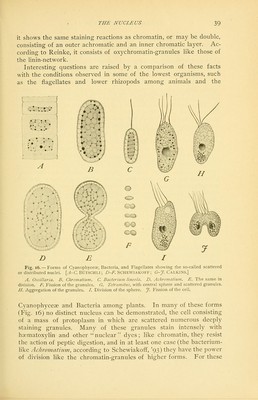
![it shows the same staining reactions as chromatin, or may be double, consisting of an outer achromatic and an inner chromatic layer. Ac- cording to Reinke, it consists of oxychromatin-granules like those of the linin-network. Interesting questions are raised by a comparison of these facts with the conditions observed in some of the lowest organisms, such as the flagellates and lower rhizopods among animals and the D E Fig. i6.— Forms of CyanopliyceEe, Bacteria, and Flagellates showing the so-called scattered or distributed nuclei. [^-C BuTSCHLl; Z)-/^. SCHEWIAKOFF; G-J. Calkins.] A. Oscillaria. B. Chromatium. C. Bacterium Uneola. D. Achroinafium. E. The same in division. F. Fission of the granules. G. Tcframitus, with central sphere and scattered granules. H. Aggregation of the granules. /. Division of the sphere, y. Fission of the cell. Cyanophyceae and Bacteria among plants. In many of these forms (Fig. 16) no distinct nucleus can be demonstrated, the cell consisting of a mass of protoplasm in which are scattered numerous deeply staining granules. Many of these granules stain intensely with hjematoxylin and other nuclear dyes; like chromatin, they resist the action of peptic digestion, and in at least one case (the bacterium- like Achroviatium, according to Schewiakoff, '93) they have the power of division like the chromatin-crranules of higher forms. For these](https://iiif.wellcomecollection.org/image/b21166493_0067.jp2/full/800%2C/0/default.jpg)