The cell in development and inheritance / by Edmund B. Wilson.
- Edmund Beecher Wilson
- Date:
- 1902, ©1900
Licence: Public Domain Mark
Credit: The cell in development and inheritance / by Edmund B. Wilson. Source: Wellcome Collection.
Provider: This material has been provided by the Francis A. Countway Library of Medicine, through the Medical Heritage Library. The original may be consulted at the Francis A. Countway Library of Medicine, Harvard Medical School.
71/522 (page 43)
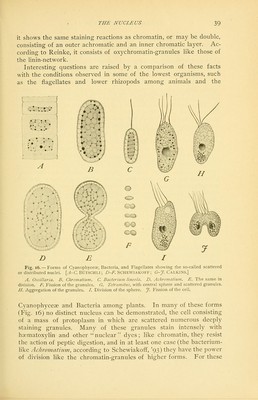
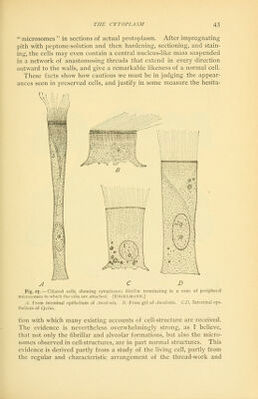
![microsomes in sections of actual protoplasm. After impregnating pith with peptone-solution and then hardening, sectioning, and stain- ing, the cells may even contain a central nucleus-like mass suspended in a network of anastomosing threads that extend in every direction outward to the walls, and give a remarkable likeness of a normal cell. These facts show how cautious we must be in judging the appear- ances seen in preserved cells, and justify in some measure the hesita- IJ!|.T«i|,rr;;l|!7 ivw ^. B mi'i .'inu^7! I 11 ina^ » *«u_'^ L A CD Fig. 17. — Ciliated cells, showing cytoplasmic fibrillce terminating in a zone of peripheral microsomes to which the cilia are attached. [Engelmann.] . /. P'rom intestinal epithelium of Anodoiita. D. From gill of Anodonta. CD. Intestinal epi- thelium of Cyclas. tion with which many existing accounts of cell-structure are received. The evidence is nevertheless overwhelmingly strong, as I believe, that not only the fibrillar and alveolar formations, but also the micro- somes observed in cell-structures, are in part normal structures. This evidence is derived partly from a study of the living cell, partly from the regular and characteristic arrangement of the thread-work and](https://iiif.wellcomecollection.org/image/b21166493_0071.jp2/full/800%2C/0/default.jpg)