The cell in development and inheritance / by Edmund B. Wilson.
- Edmund Beecher Wilson
- Date:
- 1902, ©1900
Licence: Public Domain Mark
Credit: The cell in development and inheritance / by Edmund B. Wilson. Source: Wellcome Collection.
Provider: This material has been provided by the Francis A. Countway Library of Medicine, through the Medical Heritage Library. The original may be consulted at the Francis A. Countway Library of Medicine, Harvard Medical School.
75/522 (page 47)
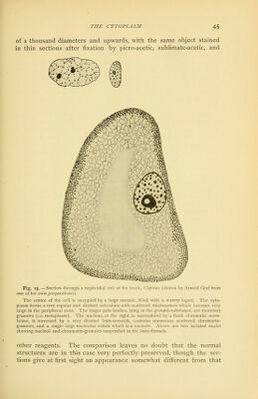
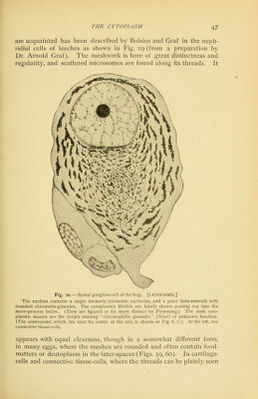
![am acquainted has been described by Bolsius and Graf in the neph- ridial cells of leeches as shown in Fig. 19 (from a preparation by Dr. Arnold Graf). The mesh work is here of great distinctness and regularity, and scattered microsomes are found along its threads. It Fig. 20. —Spinal ganglion-cell of the frog. [Lenhossek.] The nucleus contains a single intensely chromatic nucleolus, and a paler linin-netvvork with rounded chromatin-granules. The cytoplasmic fibrillEe are faintly shown passing out into the nerve-process below. (They are figured as far more distinct by Flemming.) The dark cyto- plasmic masses are the deeply staining chromophilic granules (Nissl) of unknown function. (The centrosome, which lies near the centre of the cell, is shown in Fig. 8, C.) At the left, two connective tissue-cells. appears with equal clearness, though in a somewhat different form, in many eggs, where the meshes are rounded and often contain food- matters or deutoplasm in the inter-spaces (Figs. 59, 60). In cartilage- cells and connective tissue-cells, where the threads can be plainly seen](https://iiif.wellcomecollection.org/image/b21166493_0075.jp2/full/800%2C/0/default.jpg)