Dr. Ballard's report to the local government board on an epidemic of enteric fever at Newlyn, in the rural sanitary district of St. Columb, Cornwall.
- Ballard, Edward
- Date:
- 1880
Licence: Public Domain Mark
Credit: Dr. Ballard's report to the local government board on an epidemic of enteric fever at Newlyn, in the rural sanitary district of St. Columb, Cornwall. Source: Wellcome Collection.
Provider: This material has been provided by London School of Hygiene & Tropical Medicine Library & Archives Service. The original may be consulted at London School of Hygiene & Tropical Medicine Library & Archives Service.
5/8 page 3
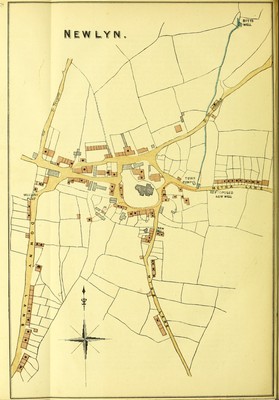
![instances I saw from two to four persons in a house sick with enteric fever in various stages and of various grades of severity. The number of deaths up to November 1st had been nine (one of these questionably due to fever). At my first visit I found that the Authority had closed the town well on October 1, since the Medical Officer of Health had attributed the spread of 'the fever to its use, and that Mr. Yigurs had been supplied with disinfectants for use in the houses of the sick. Private efforts Lad just commenced to he made to supply drinking water by means of a small watercart, hut the majority of the population wrere obtaining water from Butt’s spring. The Authority were erecting a windlass over and deepening the “ new well ” so as to obtain water from it; and removing from the “ western well ” the old pump, the iron pipe of which was believed by its corrosion to have rendered the water distasteful. They were also negotiating for a site for a new well at the roadside not far from the town pump. The Authority were thus carrying out in the best way that occurred to them the recommendations of their medical adviser. Accurately determining the dates of the first definite symptoms in the earlier cases of fever, I found that the first three cases of which 1 could obtain any information commenced respectively on the 16th, 17th, and 18th of September; that the next seven cases commenced on September 19th, and the next 13 cases between the 20th and 23rd. Altogether at least 23 cases occurred during the first eight days of the outbreak. The first of the above cases (taken ill on September 16), was that of a young girl who had not been out of the village for a long time prior to her seizure, and who resided in a wretched dilapidated cottage without any privy, behind the church, and the slops from whose residence flowed into the town drain.* The second case (taken ill on September 17), was a little boy residing at one of the houses at the outskirts of the village in Downey Lane, and the third (taken ill on the 18th) resided in the part of the village near the church. Of the seven cases which commenced on the 19th all resided in the part of the village near the church. After these, the cases occurred in all parts of the village. The accompanying rough plan of the village indicates by black dots the houses invaded up to November 1. On lookiug at this map one cannot fail to be struck by the fact that the greater proportion of the families invaded resided in the part of the village nearest to the “ town pump,” and most conveniently situated for obtaining their water supply from this pump, and who therefore may be fairly presumed to have used the water in greatest quantity and the most freely for all purposes. As a matter of fact, all the persons taken ill early in the outbreak, and of whom I made inquiry, did use habitually for drinking purposes the water of this well. It had a high repute generally in the village. Indeed, on September 25th, Dr. Mackay was probably perfectly correct in attributing the epidemic, as he did in his report of that date, to the use of this particular well-water. There was nothing else in common to all these families besides the use of this well-water; especially there was nothing else in common to the two first families invaded on consecutive days whose residences were about a quarter of a mile apart. That this well-water was very greatly and principally concerned in the spread of the epidemic may be gathered also from this, namely, that at the date when the town-pump water ceased to be an influence [the pump was closed on October 1, and its influence would be manifested up to October 15, but not longer], the average daily number of fresh attacks fell from 2-7 to l’O; 57 cases occurred in the days September 21 to October 15 inclusive; 19 in the days from October 16 to November 1, when I left Newlyn. But it is clear that the use of this well-water was not the sole cause of the spread of the disease, or the last 19 or 20 cases would not have occurred. Three other causes at least were operative. One of these was the sale and distribution of milk throughout the epidemic from houses and families which at the time had cases of fever in them, or where infected “ town ” well-water was used for the cleansing of the vessels in which the milk was container!. Another cause was most unquestionably the use of infected * On November 15, during a slight gale of wind, this cottage actually fell, a woman who was ill with fever being in bed there at the time. A 2 Q 3531.](https://iiif.wellcomecollection.org/image/b24996919_0007.jp2/full/800%2C/0/default.jpg)