A treasury of natural history; or, a popular dictionary of animated nature ... To which are added, a syllabus of practical taxidermy, etc / [Samuel Maunder].
- Samuel Maunder
- Date:
- 1848
Licence: Public Domain Mark
Credit: A treasury of natural history; or, a popular dictionary of animated nature ... To which are added, a syllabus of practical taxidermy, etc / [Samuel Maunder]. Source: Wellcome Collection.
107/854 page 85
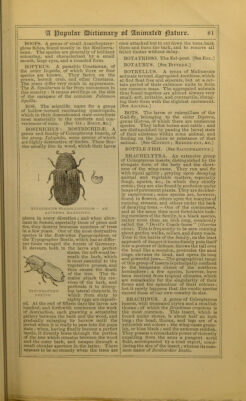
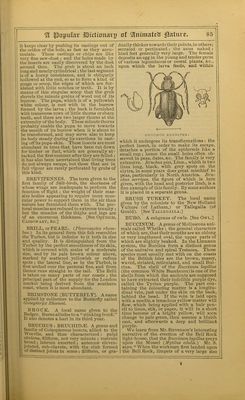
![I it keeps clear by pushing its castings out of . I the orifice of the hole, ns fast os they aecu- I inulate. These castings or chips are like very fine saw-dust ; and the holes made by the insects are easily discovered by the dust around then. The grub is about an inch long and nearl5’ cylindrical; the last segment ' is of a homy consistence, and is obliquely hollowed at the end, so os to form a kind of ! gouge or scoop, the edges of which are fur- nished with little notches or teeth. It is by I j means of this singular scoop that the grub shovels the minute grains of wood out of its , burrow. The pupa, which is of a yellowish ! white colour, is met with in the burrow formed by the larva ; the back is furnished j ■ with transverse rows of little thorns or sharp I teeth, and there are two larger thorns at the ' extremity of the body. These minute thorns ! probably enable the pupa to move towards i the mouth of its biurow when it is about to j be transformed, and may serve also to keep I its body steady during its exertions in cast- ; ing off its pupa-skin. These insects are most ■ abundant in trees that have been cut down I for timber or fuel, which are generally at- ; tacked the first summer after they are felled ; it has also been ascertained that living trees I da not always escape, but those that are in full tigour are rarely perforated by grubs of this kind. BREVIPEXIvES. The term given to the first family of Stilt-birds, the shortness of whose wings are inadequate to perform the function of flight ; the weight of their mas- sive bodies api>earing to require more mus- cular power to support them in the air than nature has furnished them with. The pec- toral muscles are reduced to extreme tenuity ; but the muscles of the thighs and legs are ' of an enormous tliickness. [See Ostrich, Cassowary, &c.] BRIIjL, or pearl. (Pleuronectcs r/iom- biis.') In its general form this fish resembles the Turbot, but is inferior to it both in size and quality. It is distinguished from the Turbot by the perfect smoothness of its skin, which is covered with scales of a moderate size, and by its pale brown colour above, marked by scattered yellowish or rufous spots ; the lateral line, os in the Turbot, is first arched over the pectoral fins, and from thence runs straight to the tail. The Brill is taken on many parts of our coasts j the prineipai part of the supply for the London market Ijcing derived from the southern coast, where it is most abundant. BRI.MSTOXE [BUTTERFLY]. A name appiicd by collectors to the Butterfly called (iirnr.pleri/x liliamni. BROCK. A local name given to the Badger. Bums alludes to a “ stinking brocA'.” It aLw denotes a hart in its third year. BHUCirUS: BRUemOzE. A genus and family of Coleopterous insects, allied to the Weevils, and thus characterized; palpi obvious, filiform, not very minute ; rostrum broad ; labnim exserted i antcnnic clcvcn- jointed, Bub-clavntc, with the club forincil of distinct joints in some; filiform, or gra- dually thicker towards their points,in others; serrated or pectinated ; the anus naked ; liind feet generally very large. The female deposits an egg in the yoimg and tender germ of various leguminous or cereal plants, &c., upon which the larva feeds, and within 1—^ 1 uaacuers asnniPEa. which it undergoes its transformations : the perfect insect, in order to make its escape, detaches a portion of the epidermis like a small cup ; hence the small holes often ob- served in peas, dates, &c. The family is very extensive. Bruchuspisi, Linn., wliich is two lines long, black, with grey spots on the elytra, in some years does great mischief to peas, particularly in North America. Bmi- chus serripes, the figure of wliich is here given, with the head and posterior limb, is a fine example of this family. By some authors it is placed in a separate genus. BRUSH TURKEY. The local name given by the colonists to the New Holland Vulture (of Latham,) or TaUegalla (of Gould). [See TALLi;oALLA.] BUBO. A subgenus of owls. [See Owl.] BUCCINUM. A genus of Molluscous ani- mals called MTielks ; the general characters of which ore, that their mouths are an oblong or very lengthened oval, the upper parts of wliich are slightly beaked. In the Linmean system, the Buccina form a distinct genus of the univalve and spiral Testacea. Those species most usually met with on the coasts of the British isles are the brown, massy, waved, striated, reticulated, and small Buc ■ cina. The shell of the Buccinum lapiUus (the common White Buccinum) is one of the shells from which the ancients are supposed to have extracted their indelible purple dye, called the Tyrian purple. The part con- taining the colouring matter is a longitu- dinal vein, just under the skin on the back, behind the head. If the vein is laid open with a needle, a tenacious yellow matter will flow, which licing ajiplicd with a hair pen- cil to linen, silk, or paper, it will in a short time become of a bright yellow, will soon change to pale green, then assume a bluish cast, and afterwards a deep and brilliant 1)11 rple. We learn from Mr. Stevenson’s interesting narrative of the erection of the Bell Rock light-house, that the Biirrlniim lapillus preys upon the Mussel IMytilus cdtdis.) Mr. S. says, “ When the workmen first landed upon the Bell Rock, limpets of a very large size 4 I](https://iiif.wellcomecollection.org/image/b22023185_0107.jp2/full/800%2C/0/default.jpg)
 No text description is available for this image
 No text description is available for this image
 No text description is available for this image