A treasury of natural history; or, a popular dictionary of animated nature ... To which are added, a syllabus of practical taxidermy, etc / [Samuel Maunder].
- Samuel Maunder
- Date:
- 1848
Licence: Public Domain Mark
Credit: A treasury of natural history; or, a popular dictionary of animated nature ... To which are added, a syllabus of practical taxidermy, etc / [Samuel Maunder]. Source: Wellcome Collection.
110/854 page 88
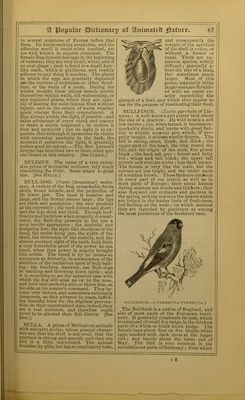
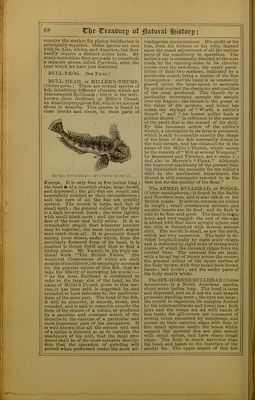
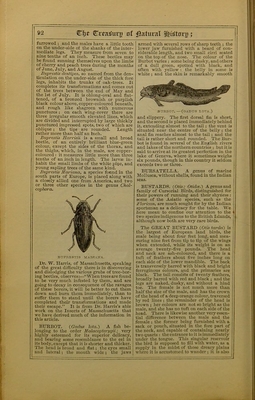
![CrcaiSury of i^atural ; country the market for piping-bullfinches is principally supplied. Other species are met with in Asia» Africa, and America; but they hardly require a distinct notice here. By many naturalists they are made to constitute a separate genus, called Pyrrhula^ after the type which we have just described, BTJIjL-FIIOG. [See Fhog.] BUBL-HEAD, or MILLER’S-THUMB. (CottiiS gobio.) There are several species of fish, inhabiting different climates, which are denominated Bullheads ; but it is the well- known River Bullhead^ or Miller's Thumbs au A.canthopterygious fish, wluch we are now about to describe. This species is found in clear brooks and rivers, in most parts of RIVER BULr-HEAn.—(COTTUS GOBIO.) Euroi)e. It is only four or five inches long; the head fe of a roundish shape, large, broad, and depressed ; the gill-fins are round, and beautifully notched at their circumference ; and the rays of all the fins are prettily spotted. The mouth is large, and full of small teeth ; the general colour of the body is a dark brownish black ; the sides lighter, with small black spots ; and the under sur- face of the head and belly white. It is so remarkably stupid, that whatever number may be together, the most inexpert angler may catch them all. It is generally found among loose stones, under which, from the peculiarly flattened form of its head, it is enabled to tlirust itself, and thus to find a hiding place. Mr. Tarrell, in his truly na- tional work “ The British Fishes,” (the wood-cut illustrations of w’hich are such models of excellency,) so amusingly accounts for the popular names of this fish, that we take the liberty of borrowing his words : — ** As the term Bullhead is considered to refer to the large size of the head, so the name of Miller’s Thumb given to this spe- cies, it has been said, is suggested by, and intended to have reference to, the particular form of the same part. The head of the fish, it will be observed, is smooth, broad, and rounded, and is said to resemble exactly the form of the thumb of a miller, os produced by a peculiar and constant action of the muscles in the exercise of a particular and most important part of his occupation. It is well known tliat all the science and tact of a miller is directed so as to regulate the machinery of his mill, that the meal pro- duced shall be of the most valuable descrip- tion that the operation of grinding will permit when performed under the most ad- vantageous circumstances. His profit or his loss, even his fortune or his ruin, depend upon the exact adjustment of all the various parts of the machinery in operation. The j miller’s ear is constantly directed to the note I made by the running-stone in its circular 1 course over the bed-stone, the exact paral- j lelism of their two surfaces, indicated by a ' particular sound, being a matter of the first i consequence ; and his hand is as constantly i placed under the meal-spout, to ascertain I by actual contact the character and qualities of the meal produced. The thumb by a particular movement spreads the sample over the fingers ; the thumb is the guage of the value of the produce, and hence has arisen the sayings of “Worth a miller’s thumb;” and “An honest miller hath a golden thumb ; ” in reference to the amount of the profit that is the reward of his skill. By this incessant action of the miller’s thumb, a peculiarity in its form is produced, which is said to resemble exactly the shape of the head of the fish constantly found in the mill-stream, and has obtained for it the ! name of the IVIiller’s Thumb, which occurs i in the comedy of “ Wit at several Weapons,” by Beaumont and Fletcher, act v. scene 1. ; and also in Merrett’s “ Pinax.” Although the improved machinery of the present time has diminished the necessity for the miller’s skill in the mechanical department, the thumb is still constantly resorted to as the best test for the quality of the flour.” The ARMED BUELHEAD, or POGGE, {^Cottiis aspidophOT^s^') is found in the Baltic and Northern seas, and is also taken on the British coasts. It seldom exceeds six inches in length ; small crustaceous animals and aquatic insects are its food; and its flesh is said to be firm and good. The liead is lai^e, bony, and very rugged; the end of the nose is armed with four short upright spines; and the chin is furnished with several minute cirri. The mouth is small, as are the teeth, which are very numerous. .The body is di- vided longitudinally by eight scaly ridges, and is defended by eight rows of strong scaly plates, of wliich the elevated ridges form the central lines. The pectoral fins are large, ^vith a broad bar of brown across the centre; the general colour of the upper surface of the body brown, with four broad dark brown bunds ; tail brown ; and the under i)arts of the body nearly white. The SrX-nORNEDBXJLEnE^VD {CotUa hcxacornis) is a North American species, about seven inches long. The hea<l is large and depressed, and on it are six nail-shaijcd processes standing erect; the eyes are large ; the mouth is capacious, its margins formed by the intermaxillaries and low'er jaw; both jaw’s and the vomer are set with bands of fine teeth; the gill-covers are composed of several bones connected by membrane, and armed on their exterior edges with four or five small spinous teeth; the lioncs w’hich supjiort the jicctoral fins are also armed with small spines, and have sharp rough edges. The body is much narrower than the head, and tapers to the insertion of the caudal fin. The upi>er aspect of this fish](https://iiif.wellcomecollection.org/image/b22023185_0110.jp2/full/800%2C/0/default.jpg)
 No text description is available for this image
 No text description is available for this image
 No text description is available for this image