A treasury of natural history; or, a popular dictionary of animated nature ... To which are added, a syllabus of practical taxidermy, etc / [Samuel Maunder].
- Samuel Maunder
- Date:
- 1848
Licence: Public Domain Mark
Credit: A treasury of natural history; or, a popular dictionary of animated nature ... To which are added, a syllabus of practical taxidermy, etc / [Samuel Maunder]. Source: Wellcome Collection.
25/854 page 3
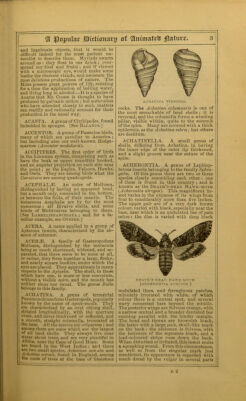
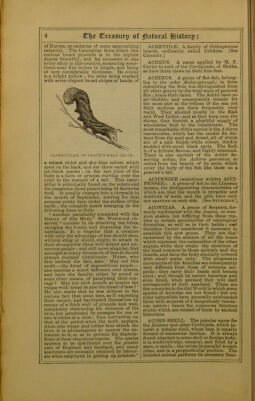
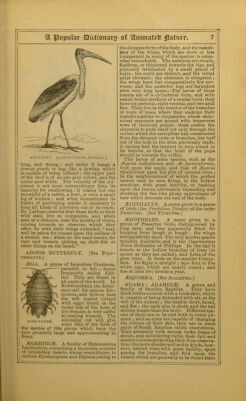
![Q lOnjiuIar JBicttanary of ^ntmatcir ^Saturc. and inanimate objects, that it would be difficult indeed for the most patient na- turalist to describe them. Myriads swarm around us : they float in oim drink ; over- spread our food and fruits ; and if viewed with a microscopic eye, would make some loathe the choicest viands, and nauseate the most delicious i)roductions of nature. The Alites possess great powers of life, resisting for a time the application of boiling lyater, and li\dng long in alcohol.—It is a species of Acanis that Mr. Crosse is thought to have produced by galvanic action ; but naturalists who have attended closely to such matters can readily and rationally account for their production in the usual way. ACASTA. A genus of Cirrhipedes, found imbedded in sponges. [See Balanus.] ACCENTOR. A group of Passerine birds, many of which are peculiar to America j ! but including also our well-known Hedge- I sparrow (Accentor modularis'). ' ACCIPITRES. The first order of birds in the Linna:an system, comprising such as have the beak or upper mandible hooked, and an angular projection on each side near the point; as the Eagles, Falcons, Hawksi I and Owls. They are among birds what the Carnivora are among quadrupeds. ACEPITAErE. An order of Mollusca, distinguished by having no apparent head, but a mouth oniy, concealed in the bottom, or between the folds, of their mantle. Tlie testaceous Acephalm are by far the most numerous ; all Bivalve shells, and some I kinds of Multivalves belonging to them, j [See EAMJjLunnANcniATA ; and for a fa.- I miliar example, sec Ovster.] I ACERA. A name applied to a group of : Apterous insects, characterized by the ab- sence of antenna:. ACER.Fl. A family of Gasteropodous Mollu.sca, distinguished by the tentacula being so much shortened, widened, and se- parated, that there seem to be none at all, or rather, they fonn together a large, fleshy, and nearly s<|Unre buckler, under which the eyes are placed. They approximate in many i respects to the Aplysue. The shell, in tliose which have one, is more or less convoiute, without a visible spire, and the mouth has neither sinus nor canal. The genus liulla belongs to this family. ACHATINA. A genus of terrestrial Pnciimonobrnnchous Gastcropods, popularly known by tlie name of nyate-snaih. They are characterized liy an oval olilong shell, striated longitudinally, with the aperture ovate, and never thickened or reflected, and a smooth, straight columella, truncated at the base. All tlic s|>cclcs are oviparous ; and amona them arc some which arc the lorgcst of all land shells. They always live near water alsiut trees, and arc very plentiful in Africa, near the Cape of 0(M)d Ilo|ie. Some are found in the West Indies ; and there are two small species, zlc/n//oia acifytla and Achntmn m-loiui, found in England, among the roots of trees at the base of limestone 3 ACHATINA VIRGINIA. rocks. The Achatina columnaris is one of the most remarkable of land shells ; it is reversed, and the columella forms a winding pillar, visible within, quite to the summit of the spire. Many are covered with a thick epidermis, as the Acluxtina zebra; but others are destitute. ACHATINELLA. A small genus of shells, differing from Achatina, in having the inner edge of the outer lip thickened, and a slight groove near the suture of the spire. ACHERONTIA. A genus of Lepidop- terous insects belonging to the family NijAin- gkloe. Of this genus there are two or tliree species closely resembling each other: one of these is found in tliis country ; and is known as the Death’s-head IIawk-jioth (Acherontia atropos). This magnificent in- sect varies in the expanse of its wings from four to considerably more than five inches. The upper pair are of a very dark brown colour, varied with black, especially near the base, near which is an undulated bar of pale oclire: the disc is varied with deep black DEATn'S-nEAD nAWK-ATOTU (aohbrontia Arnoros.l undulated lines, and ferruginous patches, minutely irrorated with white, of which colour there is a central spot, and several wavy connected bars beyond the middle. The jiosterior wings are fulvous orange, with a narrow central and a broader dentated bar running parallel with the hinder margin. The head and thorax arc brownish black, the latter with a large pale, skull-like mark on the back : the abdomen is fulvous, with the Incisures of the scgincnts black, and a lend-C(doured stripe runs down the back. When disturbed or irritated, this insect emits a squeaking sound. From this circumstance, as well as from the singular mark just mentioned, its appearance is regarde<l with much dread by tlio vulgar in several parts](https://iiif.wellcomecollection.org/image/b22023185_0025.jp2/full/800%2C/0/default.jpg)
 No text description is available for this image
 No text description is available for this image
 No text description is available for this image