A treasury of natural history; or, a popular dictionary of animated nature ... To which are added, a syllabus of practical taxidermy, etc / [Samuel Maunder].
- Samuel Maunder
- Date:
- 1848
Licence: Public Domain Mark
Credit: A treasury of natural history; or, a popular dictionary of animated nature ... To which are added, a syllabus of practical taxidermy, etc / [Samuel Maunder]. Source: Wellcome Collection.
26/854 page 4
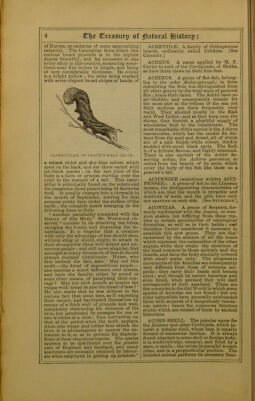
![of Europe, as ominous of some approaching calamity. The Caterpillar from which this curious insect proceeds is in the highest degree beautiful, and far surpasses in size every other in this country, measuring some- times near five inches in length, and being of very considerable tliickness. Its colour is a bright yellow ; the sides being marked with seven elegant broad stripes or bands, of 0tTERPTI.IiA.B. OF ’DFiTH'S-HEAD MOTH. a mixed violet and sky-blue colour, which meet on the back, and are there varied with jet-black specks : on the last joint of the body is a horn or process, curving over the joint in the manner of a tail. Tliis cater- pillar is principally found on the potato and the j essamine, those plants being its favourite food. It usually changes into a chrysalis in the month of September, retiring for that purpose pretty deep under the surface of the earth ; the complete insect emerging in the following June or July. “ Another peculiarity connected with the history of this Moth,” Mr. Westwood ob- serves, “ consists in its attacking bee-hives, ravaging the honey, and dispersing the in- habitants. It is singular that a creature with only the advantage of size should dare, without sting or shield, singly, to attack in their strongholds these well-armed and nu- merous people ; and still more singular, that amongst so many thousands of bees it should always contend victoriously. Huber, who first noticed the fact, asks, ‘ May not this moth — the dread of superstitious people — also exercise a secret influence over insects, and have the faculty, either by sound or some other means, of paralysing their cou- rage ? May not such sounds as inspire the vulgar with dread be also the dread of bees ? ’ He also states that he was witness to the curious fact that some bees, os if expecting their enemy, had barricaded themselves by means of a thick wall of propolis and wax, completely obstructing the entrance of the hive, but penetrated by passages for one or two workers at a time ; tlius instructing us, that at the period when the moth appears, wlien also wasps and robber bees attack the hive, it is advantageous to narrow the en- trances to it, so as to prevent the depreda- tions of these obnoxious insects. The species appears to be distributed over the greater part of England and Scotland, and many specimens arc annually obtained by lalwur- ers when employed in getting up potatoes. ACHETIDjE. a family of Orthopterous insects, ordinarily called Crickets. [See Ckicket.] ACHEIJS. A name applied by M. F. Cuvier to such of the Tardiyraxla, or Sloths, as have three claws on their fore-feet. ACHIRUS. A genus of flat-fish, belong- ing to the order Malacopterygii; in form resembling the Sole, but distinguished from all other genera by the total want of pectoral fins ; hence their name. The Achiri have no , air-bladder, and consequently remain for I the most part at the bottom of the sea; yet | their motions are there frequently very ; rapid. They abound mostly in the East and West Indies ; and as they keep near the shores, they furnish a plentiful supply of wholesome food to the inhabitants. The most remarkable of this species is the A chirus marmoratusy which has the caudal fin dis- tinct from the anal and dorsal, all of which are of a pale bluish-white colour, thickly studded with small black spots. The flesh is of a delicate flavour, and Wghly esteemed. There is also another of the Achiri de- serving notice, the Achinxs pavmicut, so called from the beauty of its spots, which cover the body of the fish like those on a peacock’s toil. ACIPENSER (sometimes written ACCI- PENSER). A genus of fish in the Linneean system, the distinguishing characteristics of wliich are, that the mouth is retractile and destitute of teeth, and the gills have only one aperture on each side. [See Stukgeox.] ACONTIAS. A genus of Serpehts, for- merly confounded with the A ngues, or com- mon snakes, but ditferin^ from those rep- tiles in certain peculiarities of osteological formation, as well as in their habits ; ai^ therefore Cuvier considered it necessary to establish tliis new genus. They are cha- racterized by the absence of all the bones which represent the extremities of the other angues, while they retain the structure of the head common to those animals and the lizards, and have the body similarly covered with small scales only. The progressive movements of the Acontias are consequently very different from those of common ser- pents : they carry their heads and breasts erect j and, though by nature harmless and even timid, when pursued they will dart courageously at their assailant. There are few countries in the Old World in which some species of Acontias are not found ; but our elder naturalists have generally confounded them with serpents of a dangerously venom- ous nature ; hence tlie numerous fabulous stories wliich are related of them by ancient historians. ACORN-SHELTj. The popular name for the Balamts and other Cirrhipeds, which in- habit a tubular shell, whose base is usually fonned of calcareous lamina;. It is always found attached to some shell or foreign body: it is multivalmlar, unequal, and fixed by a stem, or ses.sile : the valves lie parallel to each other, and in a perpendicular position. The inclosed animal performs its necessary Ainc-](https://iiif.wellcomecollection.org/image/b22023185_0026.jp2/full/800%2C/0/default.jpg)
 No text description is available for this image
 No text description is available for this image
 No text description is available for this image