A treasury of natural history; or, a popular dictionary of animated nature ... To which are added, a syllabus of practical taxidermy, etc / [Samuel Maunder].
- Samuel Maunder
- Date:
- 1848
Licence: Public Domain Mark
Credit: A treasury of natural history; or, a popular dictionary of animated nature ... To which are added, a syllabus of practical taxidermy, etc / [Samuel Maunder]. Source: Wellcome Collection.
50/854 page 28
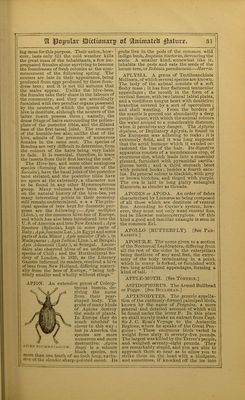
![Crpa)^uri) of crawling. The species reside in great so- cieties upon almost every species of plant, of which they suck the young shoots, leaves, and stems, by the assistance of their pro- boscis, producing disease in the plant cither by greatly weakening it, or by raising vesicles, or other gall-like excrescences, in which whole generations of Apliides reside. The anal tubercles above mentioned secrete a saccharine fluid of which ants are very fond; and it is this fluid dropped upon the adjacent leaves, or the extravasated sap flow- ing from the wounds caused by the punctures of the insects, which is known under the name of the ?umey~dew. In the spring they are viviparous, in the autumn and as ■B'inter approaches they are oviparous ; and by a surprising aberration from the common laws of nature, it appears that one im- pregnation of the female is sufficient for many generations, without further assistance from the male. All the Aphides wliich appear in the spring are exclusively females, no males being found till the autumn ; and the females are endowed with such astonish- ing fecundity, that nine generations — each generation averaging 100 individuals — have been produced witliin three months ; “ so that from a single Aphis, 10,000 million millions may be generated in that short period I ” In some years they are so nume- Pr-ANT-LICE.—(aphis PLATANOrDES.) rous as to cause almost a total failure of the hep plantations ; at other times the beans, peas, and potatoes are injured by them to an alarming extent ; as also are numerous shrubs, and plants, including the delicate exotics raised in stoves and green-houses. There are numerous species ; uniformly de- riving their specific name from the tree, slirub, or plant, on which they are common- ly found. Of these the Aphis rapes, which has made a great noise as the Aphis vastator and feeds on various plants, the Aphis rosm (or rose louse),, the Aphis humuH (or hop- fly), and the Aphis vitis (or vine-fretter), are among the best known and most destructive; but the largest and most remarkable of the British Aphides is the Aphis salicis, which is found on the different kinds of willows, and is nearly a quarter of an inch long. Many of the species have the body densely clothed with a white cottony secre- tion, either in threads or flakes i among these may be particularly mentioned the Aphis j^aturaX ; lanigera, or American blight, as it is termed, i which infests the stems of Apple-trees, some- times totally destroying them. “ The injuries occasioned by plant lice,” as Dr. Harris very truly observes, “ are much greater than would at first sight be expected from the small size and extreme weakness of the insects; but these make up by their numbers what they want in strength in- dividually, and thus become formidable enemies to vegetation. By their punctures, and the quantity of sap which they draw from the leaves, the functions of these im- portant organs are deranged or interrupted, the food of the plant, which is there elabo- rated to nourish the stem and mature the fruit, is withdrawn before it can reach its proper destination, or is contaminated and left in a state unfitted to supply the wants of vegetation. Plants are diflerently affected by these insects. Some wither and cease to grow, their leaves and stems put on a sickly appearance and soon die from exhaustion. Others, though not killed, are greatly im- peded in their growth, and their tender parts, which are attacked, become stunted, curled, or warped. The punctures of these lice seem to poison some plants, and affect others in a most singular manner, producing warts or swellings, which are sometimes solid and sometimes hollow, and contain in their interior a swarm of lice, the descendants of a single individual, whose punctures were the original cause of the tumor. I have seen reddish tumors of this kind, as big as a pigeon’s egg, growing upon leaves, to which they were attached by a slender neck, and containing thousands of small lice in their interior. Naturalists call these tumors galls, because they seem to be formed in the same way as the oak-galls which are used in the making of ink. The lice which inhabit or produce them generally differ from the others, in having shorter antennse, being without honey-tubes, and in frequently being clothed with a kind of white down, which, however, disappears when the insects become winged.” Mr. Knapp, in his ‘ Journal of a Natura- list,’ lias thus described this species, and its effects. “ Our apple-trees here are greatly injured, and some annually destroyed, by the agency of what seems to be a very feeble insect. We call it, from habit, or from some unassigned cause, the ‘ American blight.’ [It seems, however, that it had been noticed in England as early as the year 1787 ; and there is good reason to believe that in America it is not indigenous, but was in- troduced there with fruit-trees from Europe.] In the spring of the year a slight hoarincss is observed upon the branches of certain species of our orchard fruit. As the season advances this hoariness increases, it becomes cottony ; or, in other words, towards the end of summer the under sides of some of the branches are in>-ested with a thick, downy substance, so long as at times to be sensibly agitated by the air. Upon examining this substance, we find that it conceals a multi- tude of small wingless creatures, which arc busily employed in preying upon the limb of the tree beneath. 'This they are well enabled to do, by means of a Iicak termina-](https://iiif.wellcomecollection.org/image/b22023185_0050.jp2/full/800%2C/0/default.jpg)
 No text description is available for this image
 No text description is available for this image
 No text description is available for this image