A treasury of natural history; or, a popular dictionary of animated nature ... To which are added, a syllabus of practical taxidermy, etc / [Samuel Maunder].
- Samuel Maunder
- Date:
- 1848
Licence: Public Domain Mark
Credit: A treasury of natural history; or, a popular dictionary of animated nature ... To which are added, a syllabus of practical taxidermy, etc / [Samuel Maunder]. Source: Wellcome Collection.
53/854 page 31
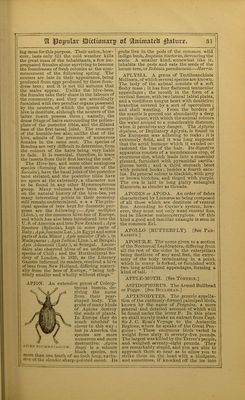
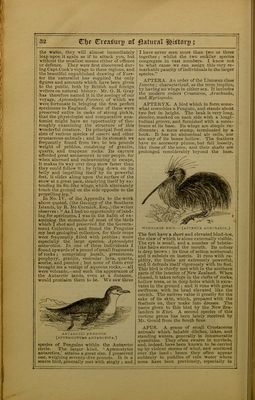
![ing moss for this purpose. Their union, how- ever, lasts only till the cold weather kills the great mass of the inhabitants, a few im- pregnated females alone surviving to become I the foundresses of fresh colonies at the com- . menccraent of the following spring. The neuters are late in their appearance, being produced from eggs produced by these foun- dress bees ; and it is not till autumn that ; the males appear. Unlike the hive-bees, j the females take their share in the labours of the community, and they are accordingly furnished with two peculiar organs possessed by the neuters, of wliich the queen of the hive is destitute, although the neuters of the latter insect possess them; namely, the dense fringe of hairs surrounding the pollen- plate of the posterior tibise, and the dilated base of the first tarsal joint. The economy of the humble-bee also, unlike that of the hive, admits of the presence of numerous females in the same nest. The species of Bombus are very dilKcult to determine, from the colours of the hairs being very liable to fade. It is essential, therefore, to trace the insects from their first lea«ng the nest.” The llive-bee, and some other analogous species (forming the second section of the f^ialesX have the basal joint of the posterior tarsi striated, and the posterior tibiie have no spurs at the extremity, a character not to be found in any other Hymenopterous group. Many volumes have been written on the natural histo^ of the hive-bee, yet many interesting points in their economy still remain undetermined. * * * The prin- cipal species of bees kept for domestic pur- : poses are the following: — Apis vicllifica ’ (I.inn.), or the common hive-bee of Europe, ' and which has also been introduced into the , U. S. of America and into New Zealand ; Apis lipustica (Spinola), kept in some parts of Italy; yi;>is/asciata(Lat.J, in Egypt and some j parts of Asia Minor ; Apis itnicolor (Fab.), in I Madagascar ; Apis Indica (Linn.), at Bengal; I Apis Adansonii (Latr.), at Senegal. Lacor- ' doire also observed hives of an undescribed , species of Chili; and the Horticultural So- ciety of I.ondon, in 182,5, ns the Literary Gazette informed its readers, received n hive of bees from New Holland, djftering materi- ! ally from the bees of Euroi^e, “ being infl- I nitely smaller and wholly without stings. APION. An extensive genus of Coleop- terous insects, de- riving the name from their pear- shaped body. The grubs of many kinds of Apions destroy the seeds of plants. In EuroiHj they do much mischief to clover in this way ; but in America the species are more numerous and more destructi ve. A pion firti/ii is a minute black species, not ! more than one tcntli of nti inch long, cxclu- I sivc of the slcnilcr sharp-jiointcd snout. Its grubs live in the pods of the common wild indigo bush, Baidisia tinctoria, devouring the seeds. A smaller kind, somewhat like it, inhabits the pods and eats the seeds of the locust-tree, or Jiohinia pseudacacia.—Harris. APLYSL.A. A genus of Tectibranchiate Mollusca, of which several species are known. The body of the animal consists of a soft fleshy mass ; it has four flattened tentacular appendages ; the mouth in the form of a vertical fissure, with two lateral labial plates, and a cordiform tongue beset with denticles; branchiffi covered by a sort of operculum ; and shell wanting. From the borders of the mantle is poured out abundantly a deep purple liquor, with wliich the animal colours the water around to a considerable distance, when it perceives any danger. The Aplysia depilans, or Depilatory Aplysia, is found in the European seas adhering to roeks : it is extremely fetid, and it was long supposed that the acrid humour which it exuded oc- casioned the loss of the hair. Its digestive apparatus consists of a membranous crop, of enormous size, which lends into a muscular gizzard, furnished with pyramidal cartila- ginous teeth ; and a third stomach beset with pointed hooks ; besides a fourth Bacil- lus. Its general colour is blackish, with grey or brown blotches, and tinged with pmple. The ova is laid in long glairy entangled filaments, as slender as threads. APODES or APODA. An order of fishes characterised by Linnasus ns being composed of all those which are destitute of ventral fins. According to Cuvier’s system, how- ever, they must not only want ventral fins, but be likewise malacopterygious. Of this kind a good and familiar example is seen in the common Eel. APOLLO [BUTTERFLY]. [See Par- NASSIUS.] APOSURiE. The name given to a section of the Nocturnal Lei>idbptern, differing from all the rest of the order in tlie caterpillars being destitute of any anal feet, the extre- mity of the body terminating in a point, which in many is forked, or furnished ivith two long articulated appendages, forming a kind of tail. APPLE-MOTH. [See Tortrix.] ASPIDOPHORUS. The Armed Bullhead or Pogge. [Sec Bulluead.] APTENODYTES. The generic appella- tion of the curiously-formed imlmiped birds, known by the name of I’cvffuiiis, a more general and detailed account of which will I he found under the letter P. In this place we shall merely make an extract from Capt. Sir J. C. Ross’s Voyage to tlie Antarctic Regions, where he speaks of the Great Pen- guins ; “ Tlicsc enormous birds varied in weight from sixty to seventy-five pounds. The largest was killed by the Terror’s people, and weighed seventy-eight pounds. They arc remarkably stupid, and j-ou are able to approach them so near ns to allow you to strike them on the head with a bludgeon, and sometimes, if knocked olf the ice into SPIOM no; i: K ;; i/.](https://iiif.wellcomecollection.org/image/b22023185_0053.jp2/full/800%2C/0/default.jpg)
 No text description is available for this image
 No text description is available for this image
 No text description is available for this image