A treasury of natural history; or, a popular dictionary of animated nature ... To which are added, a syllabus of practical taxidermy, etc / [Samuel Maunder].
- Samuel Maunder
- Date:
- 1848
Licence: Public Domain Mark
Credit: A treasury of natural history; or, a popular dictionary of animated nature ... To which are added, a syllabus of practical taxidermy, etc / [Samuel Maunder]. Source: Wellcome Collection.
63/854 page 41
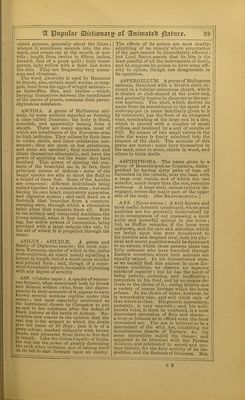
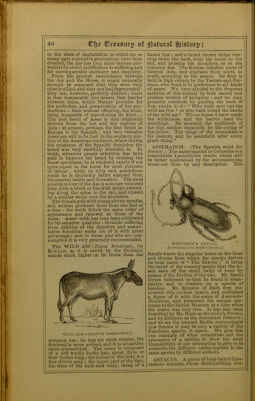
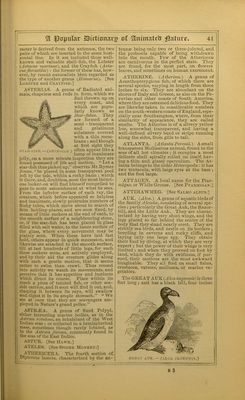
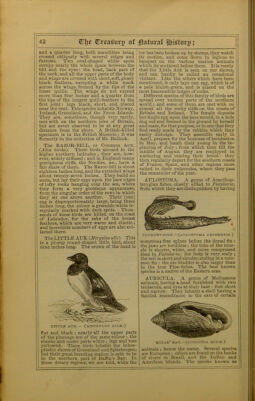
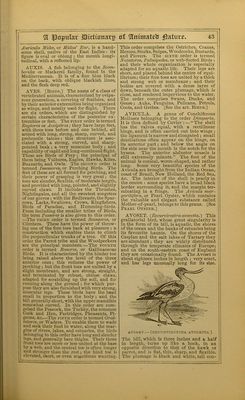
![(A.3 iEKIAS ) : meter is derived from the antenna:, the two pairs of which are inserted in the same hori- zontal line. In it are included those well- known and valuable shell-lish, the Lobster (Astacus viarinus), and the Crayfish (.Asta- cus Jiuviatilis): the former of these has, how- ever, by recent naturalists bfcen regarded as the type of another genus (Jlomarus). [See Lobster and CKAyKisii.) ASTERIAS. A genus of Radiated ani- mals, shapeless and rude in form, which wo find thrown up on every coast, and wliich are popu- larly known! as Star-J!shes. They are formed of a semi - transparent and gelatinous substance covered with a tiiin mem- brane ; and thougli at first sight they often appear like a lump of inanimate jelly, on a more minute inspection they are found possessed of life and motion. “ Let a star-fish thus picked up,” observes Mr.Rymer Jones, “ be placed in some transparent pool left by the tide, within a rocky basin ; watch it there, and, doubtless, soon the most incuri- ous looker-on will find himself compelled to gaze in mute astonishment at what he sees, i'rom the inferior surface of each ray, the creature, wliich before appeared so helpless and inanimate, slowly protrudes numbers of fleshy tubes, which move about in search of firm holding-places, and are soon fixed, by means of little suckers at the end of each, to the smooth surface of a neighbouring stone, or, if the star-fisli has been placed in glass filled with salt water, to the inner surface of the glass, where every movement may be plainly seen. When these have laid fast hold, others appear in quick succession, and likewise are attached to the smooth surface, tilt at last hundreds of little legs, for such these suckers seem, are actively employed, and by their aid the creature glides along with such a gentle motion, that it seems rather to swim than crawl. Thus roused into activity we watch its movements, and perceive that it has aiipetites and instincts which direct its course. Place within its reach a piece of tainted fish, or other sea- side carrion, and it soon will find it out, and, clasping it between its rays, will swallow and digest it In its amjde stomach.” “ We tee at once that they arc scavengers em- ployed in Nature's grand police.” ASTU/EA. A genus of fixed Polypi, either incnisting marine bodies, ns in the Aitni.a rotulom, an inhabitant of the West Indian teas ; or collected in a hemispherical ma-s, sometimes though rarely lobated, oa in the Antrfra favosa^ commonly found in tlie c.a‘, of the East Indies. ASTUR. [See Hawk.] ATEI.es. [See Spipeu Moxkey.] ATHEIUCERA. The fourth section oC nipteroin: insects, characterized by the an- tenna: being only tw'O or three-jointed, and the proboscis capable of being withdrawn into the mouth. Few of the Athericera: are carnivorous in the perfect state. They are found, for the most part, on flowers leaves, and sometimes on human excrement. ATHERINE. (Atherma.') A genus of Acanthopterygious fish, of which there are several species, varying in length from three inches to six. They are abundant on the shores of Italy and Greece, ns also on the Pe- ruvian and other coasts of South America, where they are esteemed delicious food. They are likewise taken in considerable numbers on the south-western coasts of England, espe- cially near Southampton, where, from their similarity of appearance, they are called smelts. The Atherine is of a silvery yellow hue, somewhat transparent, and having a well-defined silvery band or stripe running along the sides, from gills to tail. ATLAlNTA. (Atlanta Peronii.') A small transparent Molluscous animal, found in the seas of all hot climates ; it occupies a most delicate shell spirally rolled on itself, hav- ing a thin and glassy operculum. The At- lanta belongs to the order Heteropocla: it has two tentaciila, with large eyes at the base ; and the foot large. ATTAGEN. A local name for the Ptar- migan or 'Wliite Grouse. [See Pr.vKMiGAir.] ATTIHAWMEG. [See Salmo axbus.] AUK. (Alca.) A genus of aquatic birds of the family A Icadw, consisting of several spe- cies ; particularly the Great Auk, the Razor- bill, and the Little Auk. They are charac- terized by having ver}' short wings, and the legs placed so far belund the centre of the body that they stand nearly erect. They are strictly sea birds, and nestle on its borders ; breeding in caverns and rocky cliffs, and laying only one large egg. They obtain their food by diving, at which they are very expert j but the jiower of their wings is very limited ; and when they proceed on foot by land, which they do with swiftiiess, if pur- sued, their motions are the most awkward imaginable. They all feed on small fishes, Crustacea, vermes, molliisca, or marine ve- getables. The GREAT AUK (A lea impennis) is three feet long ; and lias a black bill, four inches OIir.AT AUK. — (ALOA IMPENNI.S.) B 3](https://iiif.wellcomecollection.org/image/b22023185_0063.jp2/full/800%2C/0/default.jpg)
 No text description is available for this image
 No text description is available for this image
 No text description is available for this image