A treasury of natural history; or, a popular dictionary of animated nature ... To which are added, a syllabus of practical taxidermy, etc / [Samuel Maunder].
- Samuel Maunder
- Date:
- 1848
Licence: Public Domain Mark
Credit: A treasury of natural history; or, a popular dictionary of animated nature ... To which are added, a syllabus of practical taxidermy, etc / [Samuel Maunder]. Source: Wellcome Collection.
71/854 page 49
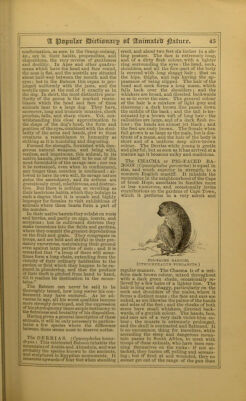
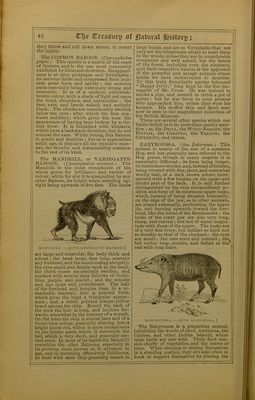
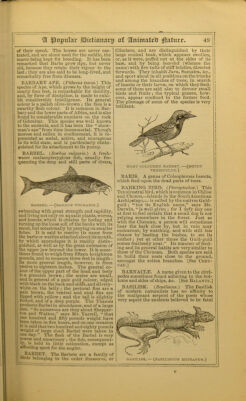
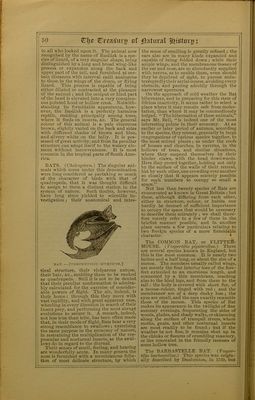
![of their speed. The horses are never eas- trated, and are alone used for the saddle, the mares being kept for breeding. It has been remarked that Barbs grow npe, but never old, because they retain their vigour to the last; they are also said to be long-lived, and remarkably free from diseases. 1 BARBARY APE. (.Pithecus imiiis.) This species of Ape, which grows to the height of nearly foiu feet, is remarkable for docility, and, by force of discipline, is made to exlii- bit considerable intelligence. Its general colom: is a palish olive-brown ; the face is a swarthy flesh colour. It is common in Bar- bary and the lower parts of Africa, and is also found in considerable numbers on the rock of Gibraltar. This species was well known to the ancients, and it has been the “ show- man’s npe” from time immemorial. Though morose and sullen in confinement, it is re- presented as social, active, and courageous in its wild state, and is particularly distin- guished for its attachment to its young. BARBEL. (Barbus vulgaris.') A fresh- water malacopterygious fish, usually fre- quenting the deep and still parts of rivers, Climbers, and are distinguished by their large conical beak, which appears swollen, or, as it were, puft'ed out at the sides of its base, and by being bearded (whence the name) -vvith five tufts of stiff bristles, directed forwards. They inhabit Java, Sumatra, &c., and sport about in all positions on the trunks and among the branches of trees, in search of insects or their larva:, on which they feed: some of them are said also to devoivr small birds and fruits j the typical genera, how- ever, appear confined to the former food. The plumage of some of the species is very brilliant. BABBSn.—(bAKBUS VUlLGARrS.) swimming with great strength and rapidity, I and living not only on aquatic plants, worms, and insects, which it obtains by boring and turning up the loose soil of the banks with its snout, but occasionally by preying on smaller fishes. It is said to receive its name from the barbs or wattles attached about its mouth, by which appendages it is readily distin- guished, as well as by the great extension of the upper jaw beyond the lower. It is some- times found to weigh from fifteen to eighteen pounds, and to measure three feet in length : its more general length, however, is from twelve to eighteen inches. The general co- lour of the upper part of the head and body is a greenish brown ; the scales are small, and in general of a pale gold colour, edged with black on the back and sidffs, and silvery- white on the belly j the iiectoral fins are a pale brown, the ventral and anal fins arc tipped with yellow •, and the tail is slightly forked, and of a deep purple. The Thames produces Barbel i n abundance, and of a large size. “ So numerous arc they about Shepper- ton and Walton,” says Mr. Yarrell, “that one hundred and fifty pounds weight have jiccn taken in five hours, and on one occasion it is said that two hundred and eighty pounds weight of large sized Barliel were taken in one day.” The flesh of tlic Barbel is very coarse and unsavoury ; the fish, consequent- ‘y- held in little estimation, except ns afiording sport for the angler. BAUBET. Tlic Bnrbcts arc a family of birds belonging to the order Sr.ansorcs, or MANY OOnOnnED BARBET. — (BUOOO VER3IOOI.OR.) BARIS. A genus of Coleopterous insects, wliich feed upon the dead parts of trees. BARKING BIRD. (Pteroptoclios.) Tliis Tenuirostral bird, which is common in Chiloe and Chonos,—^islands in the SouthAmerican Arcliipelago,— is called by the natives Guid- guid; “but its English name,” says Mr. Darwin, “is well given ; for I defy any one at first to feel certain that a small dog is not yelping somewhere in the forest. Just as with the Cheucau, a person will sometimes hear the bark close by, but in vain may endeavour, by watcliing, and with still less chance by beating the bushes, to see its author; yet at other times the Guid-guid comes fearlessly near.” Its manner of feed- ing and its general habits are very similar to those of the Cheucau. Both species are said to build their nests close to the ground, amongst the rotten branches. [See Cheu- CAC.] BARNACLE. A name given to the cirri- pedes sometimes foimd adhering to the bot- toms and sides of ships, &o. [See Balanus.] BASILISK. (Basiliscus.) The Basilisk of modem naturalists has no affinity to the malignant serpent of the poets whose very aspect the ancients believed to be fatal UABlLiaa. — (BAHILISOUS MITRATOB.)](https://iiif.wellcomecollection.org/image/b22023185_0071.jp2/full/800%2C/0/default.jpg)
 No text description is available for this image
 No text description is available for this image
 No text description is available for this image