A treasury of natural history; or, a popular dictionary of animated nature ... To which are added, a syllabus of practical taxidermy, etc / [Samuel Maunder].
- Samuel Maunder
- Date:
- 1848
Licence: Public Domain Mark
Credit: A treasury of natural history; or, a popular dictionary of animated nature ... To which are added, a syllabus of practical taxidermy, etc / [Samuel Maunder]. Source: Wellcome Collection.
72/854 page 50
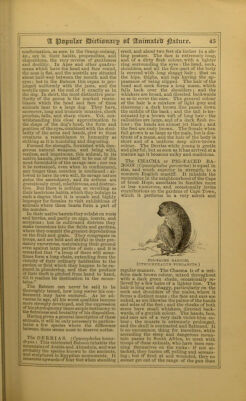
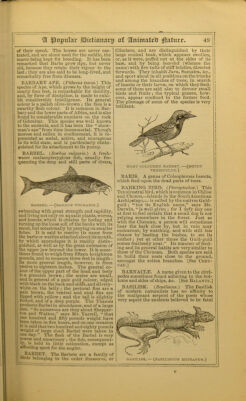
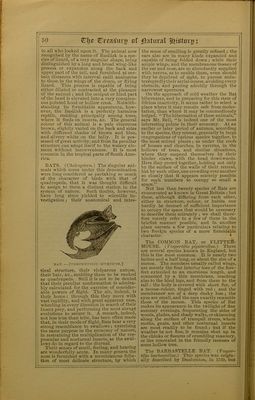
![to all who looked upon it. The animal now recogni.sed I)y the name of Basilisk is a s];e- cics of lizard, of a very singular shape, being distinguished by a long and broad wing-like lirocess or expansion along the back and upijer part of the tail, and furnished at cer- tain distances with interval radii analogous to those in the wings of the draco, or flying lizard. This process is callable of being either dilated or contracted at the pleasure of the auimal; and the occiput or hind part of the head is elevated into a very conspicu- ous pointed hood or hollow crest. Notwith- standing its formidable appearance, how- ever, the Basilisk is a perfectly harmless reptile, residing principally among trees, where it feeds on insects, &c. The general colour of this animal is a pale cinereous brown, slightly varied on the back and sides with different shades of brown and blue, and silvery white on the belly. It is pos- I sessed of great activity, and from its peculiar ; structure can adapt itseif to the W'atery ele- ; ment without inconvenience. It is most common in the tropical parts of South Ame- rica. BATS. {Cheiroptera.') The singular ani- mals which come under this denomination were long considered as partaking so much of the character of birds with that of quadrupeds, that it wns thought difficult to assign to them a distinct station in the system of nature. Such doubts, however, have long since yielded to scientific in- vestigation ; their anatomical and intes- niX. — (VE8PF.RTII.TO MURINTTS.) tinal structure, their viviparous nature, their hair, &c., entitling them to be ranked as quadrupeds. Still it is not to bo denied that their peculiar conformation is admira- bly calculated for the exercise of consider- able powers of flight. The air, indeed, is their home: through this they move with vast rapidity, and with great apparent case, wheeling in every direction in search of their insect prey, and performing the most abrupt evolutions to secure it. A remark, indeed, not less true than trite, has been often made that, in their mode of flight. Bats bear a very strong resemblance to swallows ; exercising the same purpose in the economy of nature, in restraining the multii>lication of the cre- puscular and nocturnal insects, as the swal- lows do in regard to the diurnal. Their senses of smell, feeling, and hearing arc wonderfully acute. In many genera the nose is furnished with a membranous folia- tion of most delicate structure, by which the sense of smelling is greatly refined ; the ears also are in many kinds exjianded and callable of being folded down ; while their ample wings, and the membranous tissues of the ear and nose, are so abundantl3’ supidied with nerves, as to enable them, even should they be deprived of sight, to pursue unin- tcrruptedlj'their aerial course, avoiding every obstacle, and iinssing adroitly through the , narrowest apertures i On the approach of cold weather the Bat i hibernates, and in preparing for this state of i lifeless inactivity, it seems rather to select a place where it may remain safe from moles- tation, than where it may be commodiouslv lodged. “ The hibernation of these animals,’’ says Mr. Bell, “is indeed one of the most interesting points in their economy. At an earlier or later period of autumn, according to the species, they retreat, generally in large congregations of various species together, to the most retired places ; as under the roofs of houses and churches, in caverns, in the hollows of trees, and similar situations, where they suspend themselves by their hinder claws, with the head downwards, j Here they crowd together, holding not onlj' , by the surface of the walls of their retreat, ; but by each other, one crowding over another j so closely that it appears scarcely possible j for such numbers to occupj- so small a i space.” I Not less than twenty species of Bats are | enumerated as known in Great Britain ; but j these, although differing from each other, j either in structure, colour, or habits, can hardly be deemed of sufficient importance to occupj' the space that would be necessary to describe them minutely ; we shall there- fore merely refer to a few of them in the briefest manner possible, and in another place narrate a few particulars relating to two foreign species of a more formidable character. 1 The COJIMON BAT, or FLITTER- MOUSE. {i^cspertilio pipKrelhts.) There are several species known in England, but this is the most common. It is near!}- two inches and a half long, or about the size of a mouse. The members usually called \rings, are merely the four interior toes of the fore- feet extended to an enormous length, and connected by a thin membrane, rcatdiing also to the hind legs, and from tlicm to the tail: the body is covered with short fur, of a mouse-colour, tinged with red; and the membranes' arc of a deep dusky hue; the eyes are small, and the ears exaetlv resemble those of the mouse. This si>ecies of Bat makes its appearance in the twilight of fine summer evenings, frequenting the sides of woods, glades, and shady walks, or skimming along the surface of tranquil rivers, where moths, gnats, and other nocturnal in.sccfs are most rcatlily to be found ; but if tbe weather Ite not fine, it remains shut up in the chinks or fissures of crumbling ma.sonry, or lies concealed in the friendly recesses of some hollow tree. The B.\RB.\STEEEE B.\T. (IVs;>er- tUio barlKUtelius.) This siwcics was origin- all3' described by Duubeiiton, in 175P, but](https://iiif.wellcomecollection.org/image/b22023185_0072.jp2/full/800%2C/0/default.jpg)
 No text description is available for this image
 No text description is available for this image
 No text description is available for this image