A treasury of natural history; or, a popular dictionary of animated nature ... To which are added, a syllabus of practical taxidermy, etc / [Samuel Maunder].
- Samuel Maunder
- Date:
- 1848
Licence: Public Domain Mark
Credit: A treasury of natural history; or, a popular dictionary of animated nature ... To which are added, a syllabus of practical taxidermy, etc / [Samuel Maunder]. Source: Wellcome Collection.
84/854 page 62
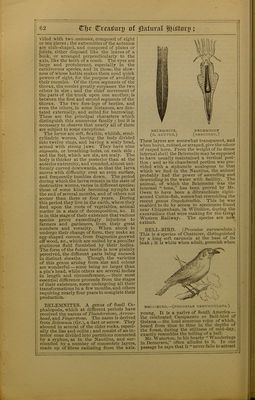
![vided with two. antennw, composed of eight or ten pieces j the extremities of the antennaj are club-shaped, and composed of plates or joints, cither disposed like the leaves of a book, or arranged perpendicularly to the axis, like the teeth of a comb. The eyes are large and protuberant, especially in the carnivorous species, and in those, the slow- ness of whose habits makes them need quick powers of sight, for the purpose of avoiding their enemies. Of the three segments of the thorax, the corslet greatly surpasses the two I others in size j and the cliief movement of I the parts of the trunk upon one another, is 1 between the first and second segments of the i thorax. The two fore-legs of beetles, and i even the others, in some instances, are den- tated externally, and suited for burrowing. These are the principal characters which distinguish this numerous family ; but it is necessary to observe that nearly all of them are subject to some exceptions. The larvw are soft, flexible, whitish, semi- cylindric worms, having the body divided into twelve rings, and having a scaly head, armed with strong jaws. They have nine stigmata, or breatliing-holes, on each side ; and the feet, wliich are six, are scaly. The body is thicker at the posterior than at the anterior extremity, and rounded, almost uni- formly curved downwards, so that the larva moves with difficulty over an even surface, and frequently tumbles down. The period during which the larvae remain in the state of destructive worms, varies in different species; those of some kinds becoming nymphs at the end of several months, and of others not sooner than tliroe or four years. During this period they live in the earth, where they feed upon the roots of vegetables, animal matter in a state of decomposition, &c. It is in this stage of their existence that various species prove exceedingly injurious to farmers and gardeners, from their great numbers and voracity. When about to undergo their change of form, they make an egg-shaped cocoon, from fragments gnawed j off wood, &c., which are united by a peculiar glutinous fluid furnished by their bodies. I The form of the future beetle is now plainly perceived, the different parts being encased in distinct sheaths. Though the varieties of this genus arising from size and colour ore wonderful — some being no larger than ] a pin’s head, wliile others are several inches I in length and circumference, — their most j essential difference proceeds from the stages ‘ of their existence, some undergoing all their I transformations in a few months, and othem I requiring nearly four years to complete their I production. BELEMNITES. A genus of fossil Ce- ' phalopoda, which at dinferent periods have i received the names of Thunderstonc, Arrow- ■ head, and Fingerstone. The name is derived I from Jielcmnon (Gr.), a dart or arrow. They abound in several of the older rocks, especi- ally the lias and oolite ; and consist of an in- terior cone divided into partitions connected by a syphon, os in the Nautilus, and sur- rounded by a number of concentric Inycre, mode up of fibres radiating from the axis. BELEMNITE. BELEMUITE (b, A0UTD8.) [aKSTOREB.l These layers are somewhat transparent, and ' when burnt, rubbed,or scraped, give the odour of rasped bom. From the weight of its dense internal shell the Belemnite may be supposed to have usually maintained a vertical posi- tion ; and as its chambered portion was pro- vided with a siphuncle analogous to that wliieh we find in the Nautilus, the animal j probably had the power of ascending and | descending in the water with facility. The animal, of which the Belemnite was the |; internal “ bone,” has been proved by Jlr. i Owen to have been a dibrauchiatc eight- j armed Cuttle-flsh, somewliat resembling tlie ] recent genus Onychoteuthis. This he was | enabled to do by access to specimens found 1 near Chippenham, in Wiltsliire, during the excavations that were making for the Great Western Railway. The species are now extinct. BELL-BIRD. (Procnias carunculata.'l Tills is a species of Chatterer, distinguished I by a long soft caruncle at the base of its i beak ; it is wliite when adult, greenish when BKI.r.-BIRD.—(PBOCNIAS OAKCNOOLATA.l young. It is a native of South America — the celebrated Campanero or Bell-bird of Guiana — the loud sonorous voice of wliich, heard from time to time in the depths of the forest, during the stillness of mid-day, cxactlv resembles the tolling of a liell. Mr. SVaterton, in his hearty “ Wanderings in Demcrnra,” often alludes to it. In one passage he says that it “ never fails to attract](https://iiif.wellcomecollection.org/image/b22023185_0084.jp2/full/800%2C/0/default.jpg)
 No text description is available for this image
 No text description is available for this image
 No text description is available for this image