A treasury of natural history; or, a popular dictionary of animated nature ... To which are added, a syllabus of practical taxidermy, etc / [Samuel Maunder].
- Samuel Maunder
- Date:
- 1848
Licence: Public Domain Mark
Credit: A treasury of natural history; or, a popular dictionary of animated nature ... To which are added, a syllabus of practical taxidermy, etc / [Samuel Maunder]. Source: Wellcome Collection.
92/854 page 70
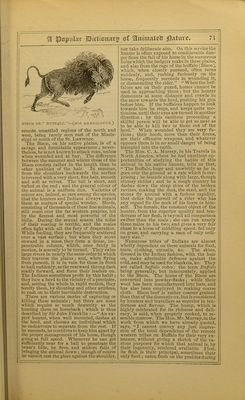
![jope ; and these are generally either clothed with warm coats of feathers, or have large quantities of fat lying beneath the skin, to defend them from the rigours of the climate. In all eUmates, however, birds are longer lived than quadrupeds of the same climates: indeed, it may be said, that, in proportion to the size of their bodies, birds possess more vitality, and live longer, than either man or quadrupeds. Naturalists have arranged birds in varions orders, founded on the organs of manduca- tion and prehension. The following is that of Cuvier: — 1. Birds OF Prey (Accipitres, Lin.) ; distinguished by their crooked beak and claws, by means of whieh they are ena- bled to overcome and prey upon other birds, and even the weaker quadrupeds. They hold the same rank among birds as the Carnivora among quadrupeds. They all have four toes, and the nails of the great and middle toes are the strongest. They form two families, the dmrnal&riA nocturnal, the first having nostrils inserted in a naked cere, three toes before and one behind, with- out feathers j eyes dii'ected sideways : the seeond having nostrils at the anterior edge of the cere, which is more or less covered with stiff hairs ; the external toe capable of being turned beliind; eyes large, directed forwards 2. Passerine Birds (Passeres'). Tills is the largest class, and embraces all birds which do not belong to the other five. They present a great resemblance in their structure, and the genera are so closely allied that it is difficult to distinguish between them. They maji, however, be separated into two great divisions : 1. Those with the exterior toe united to the middle one, by one or two joints only; and, 2. Exterior toe almost as long as the middle one, and united to it as far as the last joint but one.—3. Cumbers (Scayisores). Birds w'hose exterior toe directs itself backwards like the great toe, affording a very solid support, by which some of them cling to and climb the trunks of trees.— 4. Gallinaceous Birds. (Gallinacece.) These have a heavy gait, a short fiight, a meilimn-sized beak, the upper mandible vaulted, nostrils partly covered by a cartila- ginous scale, toes generally dentated at the edges, with short membranes between those in front 5. Waders (Grallce') may be re- cognised by the nudity of the lower part of their thighs ; very frequently by the length of their legs ; and generally by some little web, at least, between the external toes. In flying, they extend their legs behind them, contrary to the habit of other birds, who draw them up close to the body.—0. Web- footed Birds (^Palmipedes') are strongly characterised by their feet, formed for swim- ming, being affixed to the liindcr part of their body ; with very short and compressed tarsi; and palmated between the toes. They are the only birds in which the length of the neck exceeds that of the legs. Each of these orders is subdivided into families and genera, iirincipally according to the for- mation of the beak ^Eor much information on the habits of Birds wc would refer to the pages of Loudon's Magazine of Natural History, and to tlie oven more interesting work edited by Mr. Newman, and called “ The Zoologist.” I BIRGITS. A genus of long-tailed Crus- toceous animals, of which the Purse-crab (Bh'pits latro) is the largest. This species of laud-crab is a native of Amboyna, and other neighbouring islands, where it is said to inliabit the fissures of rocks or holes in the earth by day, and to come forth at night to seek its food on the lieoch. Some say it climbs cocoa-nut trees in the night to get the cocoa-nuts; and it is certain it can ; subsist on them, as well as on some other kinds of nuts, when more favourite food ^ is not easily attainable. When properly ! dressed, this animal is regarded as an ex- cellent dish. [See Crab.] BISON. There are two kinds of Bison ; one of them Eiuopean, which is now become very scarce ; the other American, which stUl exists in vast numbers. The EUROPEAN BISON (Bos bonasus) is as large os a bull or ox ; and in his native ' state of wildness, is distinguished not only by Ms size and the fleshy protuberance on lus shoulders, but by the superior depth and shag- ■ giness of his hair, which about the head, neck, ' and shoulders, is sometimes so long as almost to touch the ground. The head is small; the eyes are red and fiery ; the forehead is vide; and the horns are short, extremely strong, sharp-pointed, and stand distant from each other at their bases, like those of the common bull. His colour is a dark rufous brown, sometimes nearly black ; his limbs remark- ably strong ; and his whole aspect in the highest degree savage and gloomy. The principalEuropean regions where this animal ‘ is at present found, are the marshy forests of Poland, the Carpathian mountains, and Li- thuania. Its chief Asiatic residence is the ' neighbourhood of Blount Caucasus. This 4 animal is very scarce, and would probably i soon be extinct but for the strict orders of the emperor of Russia, who will not permit any to be shot in his dominions. Tliis mon- i arch has lately presented a stuffed specimen i and skeleton of one to the British Museum. | The AMERIC^VN BISON. (Bos Amert- ’ canus.) The American Bison, most fre- , quently called “ the Buffalo,” differs from | the European chiefly in being larger, more shaggy, in having a more protuberant bunch over the shoulders, and by the length and i fineness of its woolly hair. The hump is oblong, diminishing in height posteriorly, and gives a considerable obliquity to the outline of the back. The hair over the head, neck, and fore-part of the liody is long and shaggy, forming a beard lieneath ' the lower jaw,' and descending below the : knee in a tuft. The hair on the top of the head rises in a dense mass, nearly to the I tips of the horns, and, directly on the front, i is curled and matted strongly. The numbers | of this species still existing arc surprisingly great, when we consider the immense de- struction which annually takes plai-c. They were once extensively diffused over the what is now the territory of the United .''tates, but they arc no longer found except in the](https://iiif.wellcomecollection.org/image/b22023185_0092.jp2/full/800%2C/0/default.jpg)
 No text description is available for this image
 No text description is available for this image
 No text description is available for this image