A treasury of natural history; or, a popular dictionary of animated nature ... To which are added, a syllabus of practical taxidermy, etc / [Samuel Maunder].
- Samuel Maunder
- Date:
- 1848
Licence: Public Domain Mark
Credit: A treasury of natural history; or, a popular dictionary of animated nature ... To which are added, a syllabus of practical taxidermy, etc / [Samuel Maunder]. Source: Wellcome Collection.
95/854 page 73
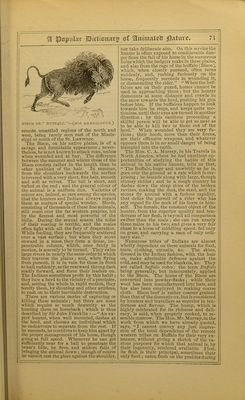
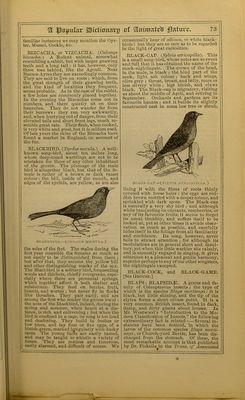
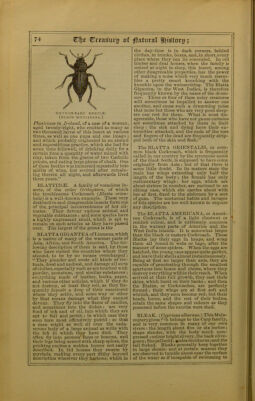
![familiar instances we may mention the Oys- ter, Mussel, Cockle, &e. BIZCACHA, or \MZCACHA. iCalomus hizcacha.') A Rodent animal, somewhat resembling a rabbit, but with larger gnawing teeth and a long tail: it has, however, only three toes behind, like the Agouti. Near Buenos Ayres they are exceedingly common. They are said to live on roots ; which, from the great strength of their gnawing teeth, and the kind of localities they frequent, seems probable. As in the case of the rabbit, a few holes are commonly placed together. In tlie evening the Bizcachos come out in numbers, and there quietly sit on their haunches. They do not wander far from their burrows: they run very awkwardly, and, when hurrying out of danger, from tlielr elevated tails and short front legs, much re- semble great rats. Their flesh, when cooked, is very white and good, but it is seldom used. Of late years the skins of the Bizcacha have found a market in England, on account of the fur. i BBACKBIRD. iTurdus nicrida.) A well- known song-bird, about ten inches long, ; whose deep-toned warblings are not to be • mistaken for those of any other inhabitant ! of the groves. The plumage of the male 1 bird is altogether black, but that of the fe- . male is ratlier of a brown or dark russet ! colour: the bill, inside of the mouth, and edges of the eyelids, are yellow, as are also ni.AOzuiao.—MSRcr.A.) the soles of the feet. The males during the first year resemble the females so much os not easily to be distinguished from them ; but after that, thepr assume the yellow bill ami other distinguishing marks of the sex. The Blackbird is a solitary bird, frequenting wotxls and thickets, chiefly evergreens, espe- cially where there arc perennial springs, which together alford it both shelter ancL subsistence. They feed on lierries, fruit, in.sccts, and worms ; but never fly in flocks like thrushes. They pair early, and are among the first who render the groves vocal: the note of the Blackbird, indeed, during the spring and summer, when heard at a dis- tance, is rich and enlivening j but when the bird is confined in n cage, its song is too loud and deafening. They build in bushes or I low trees, and lay four or five eggs, of a bluish-green, marked in-cgularly with dusky spots. The young birds are co.siIy tamed, ami may be taiiglit to whistle a variety of tunes. They are restless and timorous, easily alarmed, and difficult of access. We occasionnUy hear of albinos, or white black- birds I but they are so rare as to be regarded in the light of great curiosities. BLACK-CAP. (Sylvia atricapUla). Tliis is a small song-bird, whose notes are so sweet and full that it has obtained the name of the mock-nightingale. The crown of the head, ill the male, is black ; the hind part of the neck, light ash colour ; back and wings, olive grey ; throat, breast, and belly, more or less silvery wliite ; legs bluish, and claws black. The Black-cap is migratory, visiting us about the middle of April, and retiring in September. Orchards and gardens are its favourite haunts ; and it builds its slightly constructed nest in some low tree or shrub, BliAOX-OAl^.—fBYDVTA ATRICAFir.l.A ) lining it with the fibres of roots tliinly covered with horse hairs : the eggs are red- dish brown mottled with a deeper colour, and sprinkled with dark spots. The Black-cap is naturally a very shy bird ; and although while banqueting on currants, raspbeiries, or any of its favourite fruits, it seems to forget its usual timidity, and suffers itself to be looked at, yet at other times it avoids obser- vation as much os possible, and carefully hides itself in the foliage from all familiarity and confidence. Its song, however, never fails to attract attention j for although its modulations arc in general short and desul- tory, yet when this little warbler sits calmly, and is earnestly engaged in singing, it gives utterance to a pleasant and gentle harmony, superior perhaps to any of our other songsters, the nightingale excepted. BLACK-COCK, and BLACK-GAilE. [See Grouse.] BLAPS : BLAPSID.®. A genus and fa- mily of Coleopterous insects ; the type of which is the species Blaps mortisaga: it is black, but little shining, and the tip of the elytra forms a short obtuse point. It is a very common British insect, found in dark, dam]), and dirty places about houses. In Mr Westwood’s “Introduction to the Mo- dem Class!ficalion of Insects,” the following extraordinary fact is related: — Several in- stances have been noticed, in which the larva: of the common species Blaits inorti- aaga, or Church-yard Beetle, has been dis- charged from the stomach. Of tliesc, the most remarkable account is that published by Ur. Pickells in the Trans, qj' Associated It](https://iiif.wellcomecollection.org/image/b22023185_0095.jp2/full/800%2C/0/default.jpg)
 No text description is available for this image
 No text description is available for this image
 No text description is available for this image