A treasury of natural history; or, a popular dictionary of animated nature ... To which are added, a syllabus of practical taxidermy, etc / [Samuel Maunder].
- Samuel Maunder
- Date:
- 1848
Licence: Public Domain Mark
Credit: A treasury of natural history; or, a popular dictionary of animated nature ... To which are added, a syllabus of practical taxidermy, etc / [Samuel Maunder]. Source: Wellcome Collection.
98/854 page 76
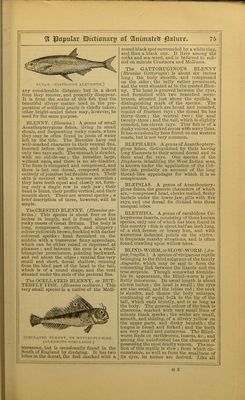
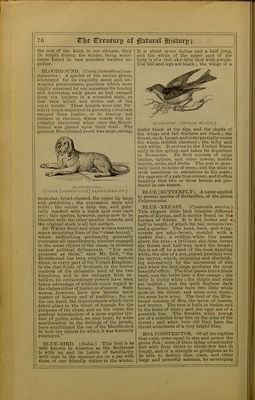
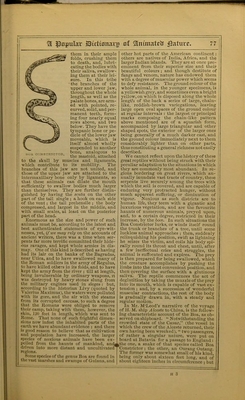
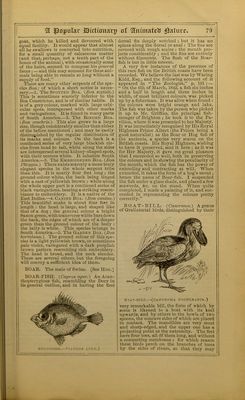
![the rest of the kind, in our climate, they lie torpid during the winter, being some- times ibnnd in vast numbers twisted to- gether. BLOODnOTJND. (Cams [domesticus'] san- guinarius.) A species of the canine genus, celebrated for its exquisite scent and un- wearied perseverance, qualities which were lughly esteemed by our ancestors for tracing and recovering such game as had escaped from the hunters in a woimded state, or had been killed and stolen out of the royal forests. These hounds were also for- merly much employed in pursuing criminals escaped from justice, or in tracing out robbers or enemies, whose course was in- evitably discovered when once the Blood- hound was placed upon their trail. The genuine Bloodhound breed was large, strong. muscular, broad-chested, the upper lip large and pendulous j the expression stem and noble s the colour a deep tan, and gene- rally marked with a black spot over each eye ; this species, however, seems now to be blended with the other smaller hounds, and the original stock is all but extinct. Sir Walter Scott and other writers narrate many surprising feats of the “ sleut-hound,” whoso unflinching pertinacity generally overcame all impediments, whether engaged in the usual objects of the chase, or directed against political delinquents. “ For such purposes as these,” says Mr. Bell, “ the Bloodhoimd has been employed, at various times, in every part of the United Kingdom: in the clan feuds of Scotland, in the border contests of the debatable land of the two kingdoms, and in the unhappy Irish re- bellion, its extraordinary powers have been taken advantage of without much regard to the claims either of justice or of mercy. Such scenes, however, have now become mere matter of history and of tradition ; for, on the one hand, the improvements which have taken place in the breed of hounds for the purposes of the chose, and on the other, the gradual introduction of a more regular sys- tem of police, aided, we may hope, by some amelioration in the feelings of the people, have annihilated the use of the Bloodhound in both the objects for which it was formerly employed.” BUUE-BIIID. (SiaUa.'l This bird is ns well known in America as the Redbreast is with us, and its habits of familiarity with man in tlie summer are on a par with those of our friendly visitor in the winter. It is about seven inches and a half long, and the whole of the upper part of the body is of a rich sky-blue shot with purple. The bill and legs are black ; the wings of a Bt,UE-niRn.—(STiUIA SIAL.rS.) dusky black at the tips, and the shafts of the wings and toil feathers are block; the | tluoat, neck, breast, and sides partially under the wings, reddish chestnut; the belly and vent white. It arrives in the United States early in the spring, and takes its departure ■ in November. Its food consists of large beetles, Binders, and other insects, besides berries, seeds, and fruits. The nest is gene- rally built in holes of trees ; and the male is ' most assiduous in attentions to his mate ; the eggs are of a pale blue colour; and it often happens that two or three broods are pro- duced in one season. BLUE [BUTTEEFUY]. A name applied ! to several species of Butterflies, of the genus Polyommatus. BLUB-BREAST. (Cyanecvla svccica.') Tliis elegant little bird inhabits different i parts of Eiuope, and is mostly found on th^ borders of forests. It is five inches and a ; half in length, of which the tail occupies two and a quarter. The head, back, and wing- coverts arc nshj’-brown, mottled with a darker tint; a reddish-white line passes above the eyes ; a brilliant sky-blue covers the throat and half-way down the breast; this is set off by a spot of the most dazzling white, the size of a pea, placed preciselj- over the larynx, wluch, enlarging and diminish- ing successively by the movement of this part when the bird sings, produces the most beautiful effect. The blue passes into a block band, and the latter into a fine orange ; the belly is dusky wliite ; the thighs and sides are reddish; and the quill feathers dark brown. Some males have two little wliite spots on the throat, and some even three; but some have none. The food of the Blue- breast consists of flies, the larvas of insects, ' and worms. The nest is built in bnshes and in the holes of trees ; and the eggs are of a greenish hue. The females, when young, ' arc of a celcstial-blue tint on the sides of the throat t and when very old they have the throat sometimes of a very bright blue. j BOA CONSTRICTOR. Of all the reptiles that exist, none equal in size and power the genus Poa; some of them being occasionally met with from thirty to thirty-five feet in length, and of a strength so prodigious ns to , be able to destroy deer, oxen, and other large and powerful animals, by cni'cloping](https://iiif.wellcomecollection.org/image/b22023185_0098.jp2/full/800%2C/0/default.jpg)
 No text description is available for this image
 No text description is available for this image
 No text description is available for this image