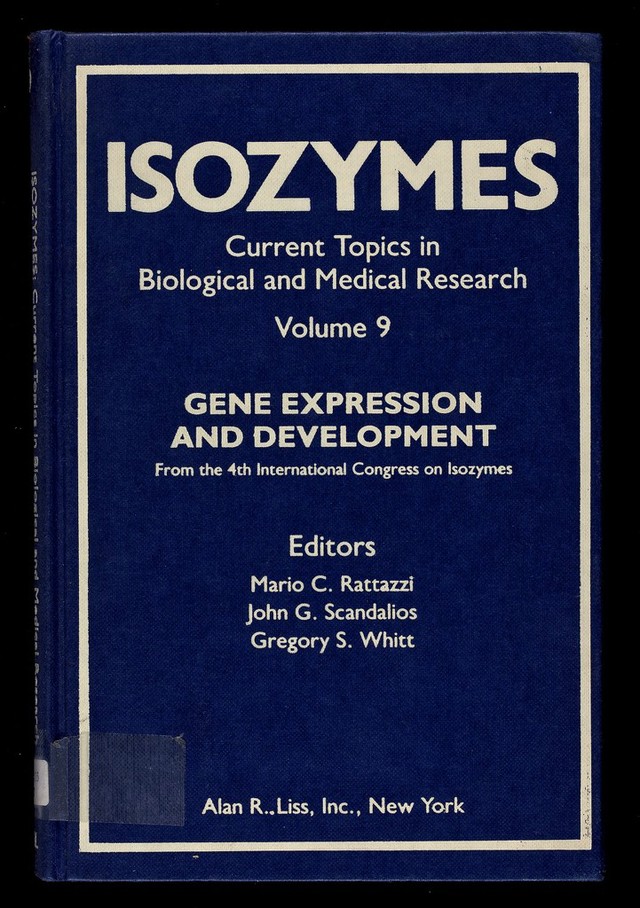
Gene expression and development : the third of five volumes constituting the proceedings of the 4th International Congress on Isozymes, held in Austin, Texas, June 14-19, 1982 / editors, Mario C. Rattazzi, John G. Scandalios, Gregory S. Whitt.
- International Congress on Isozymes
- Date:
- [cl983]
Licence: Attribution-NonCommercial-NoDerivatives 4.0 International (CC BY-NC-ND 4.0)
Credit: Gene expression and development : the third of five volumes constituting the proceedings of the 4th International Congress on Isozymes, held in Austin, Texas, June 14-19, 1982 / editors, Mario C. Rattazzi, John G. Scandalios, Gregory S. Whitt. Source: Wellcome Collection.
37/256 page 17
![Gene Regulation During Development / 17 Following equilibrium centrifugation of primary leaf extracts on sucrose gradients, two peaks of organelle associated catalase activity were observed. A minor peak was associated with particles at a density of 1.210 kg/liter, which likely represents immature peroxisomes; the second, and predominant, peak of catalase activity coincided with the mitochondrial peak at a density of 1.189 kg/liter. The mitochondrial catalase activity is exclusively due to CAT-3 [Scandalios et al, 1980b] and is tissue specific since it was found in primary leaves but not in scutella isolated from the same population of seedlings (Fig. lOB). Recall that CAT-3 is not expressed in scutellar extracts of most common inbreds, but that CAT-1 and CAT-2 are. The purity of mitochondria, peroxisomes (primary leaves) and glyoxysomes (scutella) was determined by the marker enzymes cytochrome oxidase, hydroxypyruvate reductase, and isocitrate lyase, respectively, and by the organelle specific isozymes of GOT, IDH, and MDH (see Fig. 10). In addition, electron micrographs prepared from the mitochondrial fraction (the 1.189 kg/liter peak) showed clear mitochondrial bodies without microbody contamination (Fig. 12B). Therefore, contamination of the mitochondria with microbodies seems unlikely. Cyanide insensitive respiration has been observed in the mitochondria of many plant tissues [Henry and Nyns, 1975]. Also, the production of H2O2 and the presence of catalase in the mitochondria of mung bean hypocotyl has been demonstrated [Rich et al, 1976]. It has been suggested that catalase prevents the accumulation of H2O2 produced by partial reduction of oxygen by the alternate oxidase pathway in plant mitochondria. The existence of cyanide insensitive respiration in etiolated maize epicotyls has been dem¬ onstrated [Tong and Scandalios, unpublished data] and the association of catalase with mitochondria has been observed not only in the primary leaves and coleoptiles, but also in the mesocotyls of maize [Tong and Scandalios, 1977]. These results suggest that the mitochondrial-associated catalase may be coupled with the alternate oxidase pathway. In addition, H2O2 is generated by the cyanide-resistant SOD-3 in the mitochondria, and CAT-3 may function to regulate H2O2 in this organelle. Approximately 42% of the total catalase activity associated with the mi¬ tochondria was recovered in submitochondrial particles [Scandalios et al, 1980b]. This suggests that catalase may be located either heterogeneously throughout the mitochondria, or homogeneously in the interspace of the double membranes. Since it has been proposed that the alternate oxidase is located on the outer surface of the mitochondrial inner membrane [Schon- baum et al, 1971] and assuming that catalase is coupled with the alternate oxidase pathway, it seems that the latter possibility would be more likely.](https://iiif.wellcomecollection.org/image/b18019742_0038.JP2/full/800%2C/0/default.jpg)