Gene expression and development : the third of five volumes constituting the proceedings of the 4th International Congress on Isozymes, held in Austin, Texas, June 14-19, 1982 / editors, Mario C. Rattazzi, John G. Scandalios, Gregory S. Whitt.
- International Congress on Isozymes
- Date:
- [cl983]
Licence: Attribution-NonCommercial-NoDerivatives 4.0 International (CC BY-NC-ND 4.0)
Credit: Gene expression and development : the third of five volumes constituting the proceedings of the 4th International Congress on Isozymes, held in Austin, Texas, June 14-19, 1982 / editors, Mario C. Rattazzi, John G. Scandalios, Gregory S. Whitt. Source: Wellcome Collection.
47/256 page 27
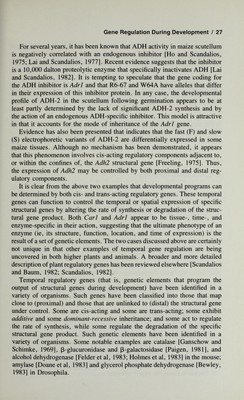
![Gene Regulation During Development / 27 For several years, it has been known that ADH activity in maize scutellum is negatively correlated with an endogenous inhibitor [Ho and Scandalios, 1975; Lai and Scandalios, 1977]. Recent evidence suggests that the inhibitor is a 10,000 dalton proteolytic enzyme that specifically inactivates ADH [Lai and Scandalios, 1982]. It is tempting to speculate that the gene coding for the ADH inhibitor is Adrl and that R6-67 and W64A have alleles that differ in their expression of this inhibitor protein. In any case, the developmental profile of ADH-2 in the scutellum following germination appears to be at least partly determined by the lack of significant ADH-2 synthesis and by the action of an endogenous ADH-specific inhibitor. This model is attractive in that it accounts for the mode of inheritance of the Adrl gene. Evidence has also been presented that indicates that the fast (F) and slow (S) electrophoretic variants of ADH-2 are differentially expressed in some maize tissues. Although no mechanism has been demonstrated, it appears that this phenomenon involves cis-acting regulatory components adjacent to, or within the confines of, the Adh2 structural gene [Freeling, 1975]. Thus, the expression of Adh2 may be controlled by both proximal and distal reg¬ ulatory components. It is clear from the above two examples that developmental programs can be determined by both eis- and trans-acting regulatory genes. These temporal genes can function to control the temporal or spatial expression of specific structural genes by altering the rate of synthesis or degradation of the struc¬ tural gene product. Both Carl and Adrl appear to be tissue-, time-, and enzyme-specific in their action, suggesting that the ultimate phenotype of an enzyme (ie, its structure, function, location, and time of expression) is the result of a set of genetic elements. The two cases discussed above are certainly not unique in that other examples of temporal gene regulation are being uncovered in both higher plants and animals. A broader and more detailed description of plant regulatory genes has been reviewed elsewhere [Scandalios and Baum, 1982; Scandalios, 1982]. Temporal regulatory genes (that is, genetic elements that program the output of structural genes during development) have been identified in a variety of organisms. Such genes have been classified into those that map close to (proximal) and those that are unlinked to (distal) the structural gene under control. Some are cis-acting and some are trans-acting; some exhibit additive and some dominant-recessive inheritance; and some act to regulate the rate of synthesis, while some regulate the degradation of the specific structural gene product. Such genetic elements have been identified in a variety of organisms. Some notable examples are catalase [Ganschow and Schimke, 1969], ß-glucuronidase and ß-galactosidase [Paigen, 1981], and alcohol dehydrogenase [Felder et al, 1983; Holmes et al, 1983] in the mouse; amylase [Doane et al, 1983] and glycerol phosphate dehydrogenase [Bewley, 1983] in Drosophila.](https://iiif.wellcomecollection.org/image/b18019742_0048.JP2/full/800%2C/0/default.jpg)