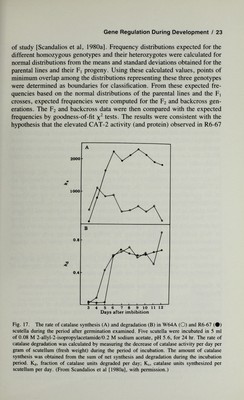
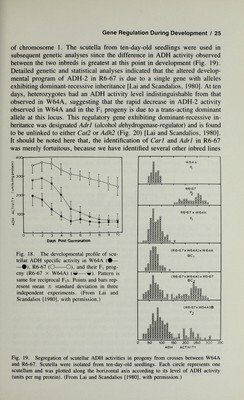
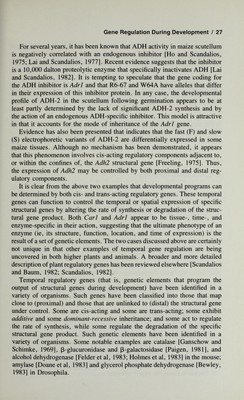
Gene expression and development : the third of five volumes constituting the proceedings of the 4th International Congress on Isozymes, held in Austin, Texas, June 14-19, 1982 / editors, Mario C. Rattazzi, John G. Scandalios, Gregory S. Whitt.
- International Congress on Isozymes
- Date:
- [cl983]
Licence: Attribution-NonCommercial-NoDerivatives 4.0 International (CC BY-NC-ND 4.0)
Credit: Gene expression and development : the third of five volumes constituting the proceedings of the 4th International Congress on Isozymes, held in Austin, Texas, June 14-19, 1982 / editors, Mario C. Rattazzi, John G. Scandalios, Gregory S. Whitt. Source: Wellcome Collection.
48/256 page 28
![28 / Scandalios The importance of regulatory genes that control the quantitative output of enzyme structural genes is also becoming much appreciated in the areas of quantitative and population genetics. My colleage, Dr. Cathy Laurie-Ahlberg and her associates have recently uncovered a substantial amount of genetic variation in the quantitative output of a number of enzyme structural genes in natural populations of Drosophila melanogaster [Laurie-Ahlberg et al, 1980]. Such regulatory variation of enzyme activity levels may provide more information and may prove a much more important source of variation for adaptive evolutionary change than structural gene variability. To date, the nature of the molecular signals or the exact mechanisms by which temporal genes exert their effect is not understood for any of the cases discussed above or presented during these Proceedings. However, substantial progress is being made in this direction by a number of investigators, in¬ cluding our laboratory, who are using gene cloning and related recombinant DNA technologies. V. CONCLUDING REMARKS I have attempted to present a few examples which clearly indicate the utility of isozymes as probes in helping us to elucidate a number of basic genetic questions at the molecular and cellular level. Many of the aspects I touched upon in a cursory manner are dealt with in more detail by other authors in these Proceedings. The available data suggest that the processes of development and differ¬ entiation are amenable to genetic analysis and that the judicious use of isozymes as probes has been an effective approach in elucidating this fact. It is also becoming apparent from studies with a variety of organisms that spatial and temporal expression of structural genes may be regulated by a system of unique DNA sequences that may reside near or away from the gene being regulated. Furthermore, these sequences, or temporal genes, are now amenable to genetic and biochemical analyses, and their analysis may shed some light on the underlying mechanisms of eukaryotic gene regulation. VI. ACKNOWLEDGMENTS I thank my students and postdoctoral associates, past and present, who contributed significantly to the research from my laboratory reviewed in this paper. I also thank numerous colleagues who reviewed the manuscript and offered constructive suggestions. Research from the author's laboratory is supported by N.LH. Research grant No. GM 22733. My gratitude is extended to Joel Chandlee for his help and contributions and to Lorraine Siebenaler and Stephanie Ruzsa for expert technical assistance.](https://iiif.wellcomecollection.org/image/b18019742_0049.JP2/full/800%2C/0/default.jpg)