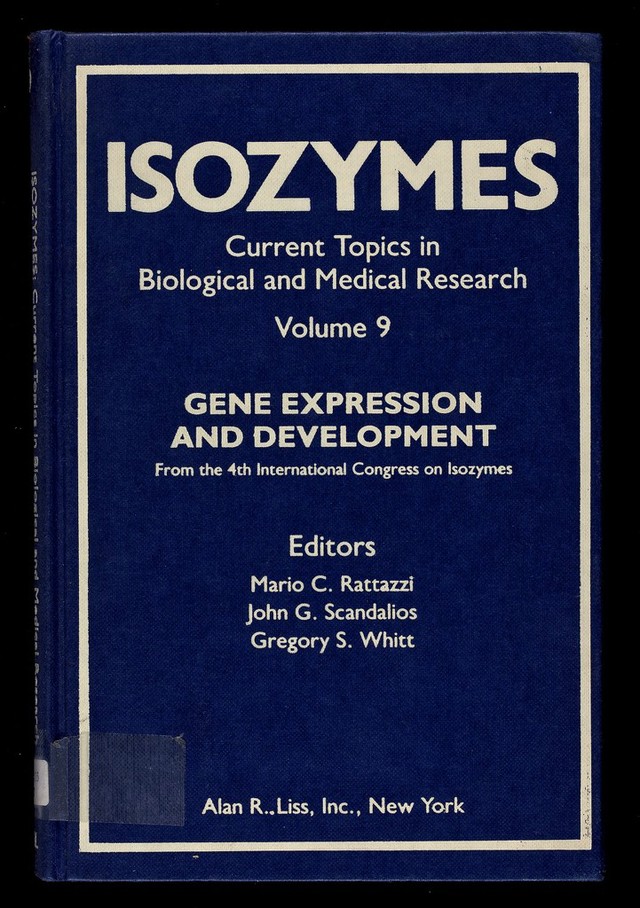
Gene expression and development : the third of five volumes constituting the proceedings of the 4th International Congress on Isozymes, held in Austin, Texas, June 14-19, 1982 / editors, Mario C. Rattazzi, John G. Scandalios, Gregory S. Whitt.
- International Congress on Isozymes
- Date:
- [cl983]
Licence: Attribution-NonCommercial-NoDerivatives 4.0 International (CC BY-NC-ND 4.0)
Credit: Gene expression and development : the third of five volumes constituting the proceedings of the 4th International Congress on Isozymes, held in Austin, Texas, June 14-19, 1982 / editors, Mario C. Rattazzi, John G. Scandalios, Gregory S. Whitt. Source: Wellcome Collection.
54/256 page 34
![34 / Bewley in programming the events leading to development. It has been well docu¬ mented that during development the eukaryotic genome is in a dynamic state with subsets of the genome being successively switched on and off in a stage- and tissue-specific manner [Ursprung, 1967; Davidson, 1976; Rogers and Sheam, 1977; Arking, 1978; Sakoyama and Okubo, 1981; and Buzin and Seecof, 1981], but there is still a paucity of information on how differential gene expression is controlled. Mutations that perturb the developmental expression of a given structural gene are therefore important in that they allow the identification of genome-encoded information that program such changes and the subsequent opportunity to probe their function at the bio¬ chemical and molecular level. In addition, epigenetic modulation of gene activity can certainly be important in terms of the expression of the final gene product and may serve as a mechanism of fine tuning and control during development. Such mechanisms could allow the differentiation of a single structural gene product, ie, either through the differential processing and splicing of a precursor mRNA molecule or the processing of a precursor polypeptide molecule, into multiple forms to fill divergent development and/ or metabolic functions. The gene-enzyme system sn-glycerol-3-phosphate dehydrogenase (GPDH, NAD^ oxidoreductase, E.G. 1.1.1.8) in Drosophila melanogaster represents an ideal system for the examination of gene expression since the activity is associated with three isozymes, identified as GPDH-1, 2, and 3, which are uniquely distributed with respect to tissue and developmental expression [Grell, 1967; Wright and Shaw, 1969; Rechsteiner, 1970; Bewley et al, 1974; Bewley and Miller, 1979; and Bewley, 1981]. Detailed genetic and protein structural studies have indicated that each isozyme is encoded by the same structural gene and that the differentiation of each molecular form represents a developmentally significant epigenetic event [Bewley and Miller, 1979; Niesel et al, 1980; Niesei et al, 1982]. In addition, this system is ideal for the screening and isolation of genetic variants that perturb the develop¬ mental program since each isozyme can serve as a tissue-specific marker. It is the purpose of this review to outline recent progress on the elucidation of events leading to the realization of GPDH isozyme expression during the development of Drosophila melanogaster. II. DEVELOPMENTAL PROGRAM The developmental program of GPDH expression has been examined in a number of inbred wild-type laboratory stocks (Figs. la,b). Wild-type Dro¬ sophila typically exhibit an increase in enzyme activity through each larval instar stage of development during which a peak is reached between five and six days after hatching of the embryo. This is followed by a rapid decline](https://iiif.wellcomecollection.org/image/b18019742_0055.JP2/full/800%2C/0/default.jpg)