Gene expression and development : the third of five volumes constituting the proceedings of the 4th International Congress on Isozymes, held in Austin, Texas, June 14-19, 1982 / editors, Mario C. Rattazzi, John G. Scandalios, Gregory S. Whitt.
- International Congress on Isozymes
- Date:
- [cl983]
Licence: Attribution-NonCommercial-NoDerivatives 4.0 International (CC BY-NC-ND 4.0)
Credit: Gene expression and development : the third of five volumes constituting the proceedings of the 4th International Congress on Isozymes, held in Austin, Texas, June 14-19, 1982 / editors, Mario C. Rattazzi, John G. Scandalios, Gregory S. Whitt. Source: Wellcome Collection.
60/256 page 40
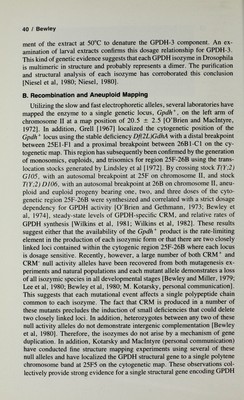
![40 / Bewley ment of the extract at 50°C to denature the GPDH-3 component. An ex¬ amination of larval extracts confirms this dosage relationship for GPDH-3. This kind of genetic evidence suggests that each GPDH isozyme in Drosophila is multimene in structure and probably represents a dimer. The purification and structural analysis of each isozyme has corroborated this conclusion [Niesel et al, 1980; Niesei, 1980]. В. Recombination and Aneuploid Mapping Utilizing the slow and fast electrophoretic alleles, several laboratories have mapped the enzyme to a single genetic locus, Gpdh^, on the left arm of chromosome II at a map position of 20.5 ± 2.5 [O'Brien and Maclntyre, 1972]. In addition. Grell [1967] localized the cytogenetic position of the Gpdh^ locus using the stable deficiency Df(2L)GdhA with a distal breakpoint between 25E1-F1 and a proximal breakpoint between 26B1-C1 on the cy¬ togenetic map. This region has subsequently been confirmed by the generation of monosomies, euploids, and trisomies for region 25F-26B using the trans¬ location stocks generated by Lindsley et al [1972]. By crossing stock T(Y;2) G105, with an autosomal breakpoint at 25F on chromosome II, and stock T(Y;2) D106, with an autosomal breakpoint at 26B on chromosome II, aneu¬ ploid and euploid progeny bearing one, two, and three doses of the cyto¬ genetic region 25F-26B were synthesized and correlated with a strict dosage dependency for GPDH activity [O'Brien and Gethmann, 1973; Bewley et al, 1974], steady-state levels of GPDH-specific CRM, and relative rates of GPDH synthesis [Wilkins et al, 1981; Wilkins et al, 1982]. These results suggest either that the availability of the Gpdh ^ product is the rate-limiting element in the production of each isozymic form or that there are two closely linked loci contained within the cytogenic region 25F-26B where each locus is dosage sensitive. Recently, however, a large number of both CRM^ and CRM null activity alleles have been recovered from both mutagenesis ex¬ periments and natural populations and each mutant allele demonstrates a loss of all isozymic species in all developmental stages [Bewley and Miller, 1979; Lee et al, 1980; Bewley et al, 1980; M. Kotarsky, personal communication]. This suggests that each mutational event affects a single polypeptide chain common to each isozyme. The fact that CRM is produced in a number of these mutants precludes the induction of small deficiencies that could delete two closely linked loci. In addition, heterozygotes between any two of these null activity alleles do not demonstrate intergenic complementation [Bewley et al, 1980]. Therefore, the isozymes do not arise by a mechanism of gene duplication. In addition, Kotarsky and Maclntyre (personal communication) have conducted fine structure mapping experiments using several of these null alleles and have localized the GPDH structural gene to a single polytene chromosome band at 25F5 on the cytogenetic map. These observations col¬ lectively provide strong evidence for a single structural gene encoding GPDH](https://iiif.wellcomecollection.org/image/b18019742_0061.JP2/full/800%2C/0/default.jpg)