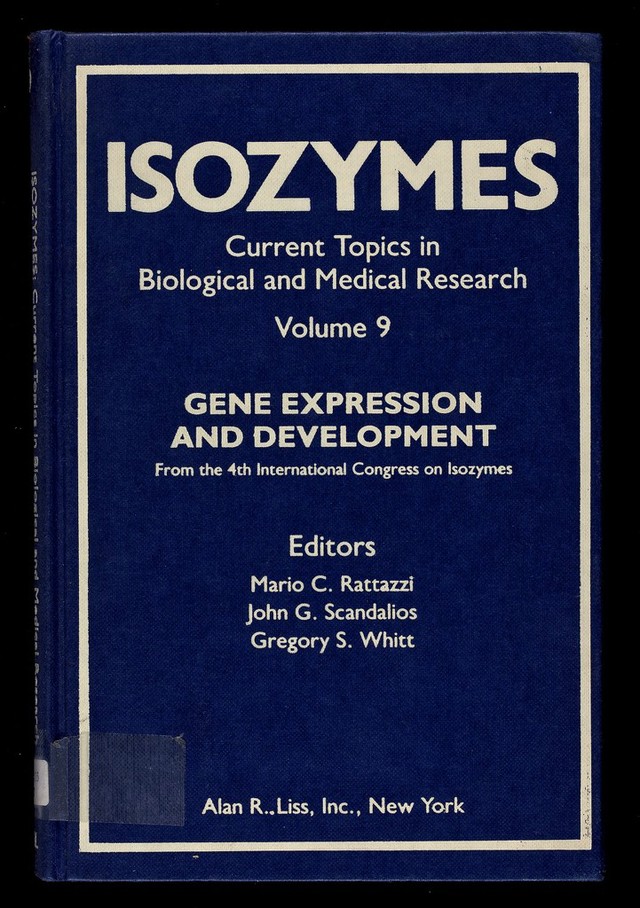
Gene expression and development : the third of five volumes constituting the proceedings of the 4th International Congress on Isozymes, held in Austin, Texas, June 14-19, 1982 / editors, Mario C. Rattazzi, John G. Scandalios, Gregory S. Whitt.
- International Congress on Isozymes
- Date:
- [cl983]
Licence: Attribution-NonCommercial-NoDerivatives 4.0 International (CC BY-NC-ND 4.0)
Credit: Gene expression and development : the third of five volumes constituting the proceedings of the 4th International Congress on Isozymes, held in Austin, Texas, June 14-19, 1982 / editors, Mario C. Rattazzi, John G. Scandalios, Gregory S. Whitt. Source: Wellcome Collection.
61/256 page 41
![Glycerol Phosphate Dehydrogenase Expression / 41 in Drosophila and suggests that the multiple molecular forms arise from epigenetic modulation during development. V. EPIGENETIC MODULATION DURING DEVELOPMENT A. Protein Structural Studies In an effort to provide definitive evidence for an epigenetic mechanism in the differentiation of each GPDH isozyme during Drosophila development and to identify any structural difference(s) that may result from such an event, each isozyme and each allelic variant has been purified to homogeneity using 8-(6-aminohexyl) amino-ATP Sepharose as an affinity ligand [Niesel et al, 1980] and subsequently subjected to a detailed structural analysis. The following represents a summation of the salient conclusions of this approach. 1. Amino acid composition analysis. The total amino acid composition of GPDH-1 for the three allelic variants and of GPDH-3 for the fast allelic variant is illustrated in Tables II and III. The compositional similarity ob- TABLE П. Amino Acid Composition of the Allelic Variants of Glycerol-3-Phosphate Dehydrogenase from Drosophila GPDH^-1 GPDH'^-l^ GPDH^^^-l' Amino acid® Experimental Integer Experimental Integer Experimental Integer ^Average of duplicate hydrolysates at 24, 48, and 72 hours. Values normalized to a subunit Mr = 32,000. ''Determined as cysteic acid, assuming 85% recovery [Hirs, 1967]. ''Values are corrected to zero-time hydrolysis. ''Values are those of 72-hour hydrolysis. 'Estimated from 12-hour duplicate hydrolysates in the presence of 2% thioglycolic acid as¬ suming 85% recovery [Matsubara and Sasaki, 1969]. ^Data for the fast and ultrafast alleles are from Niesel et al [1982].](https://iiif.wellcomecollection.org/image/b18019742_0062.JP2/full/800%2C/0/default.jpg)