Gene expression and development : the third of five volumes constituting the proceedings of the 4th International Congress on Isozymes, held in Austin, Texas, June 14-19, 1982 / editors, Mario C. Rattazzi, John G. Scandalios, Gregory S. Whitt.
- International Congress on Isozymes
- Date:
- [cl983]
Licence: Attribution-NonCommercial-NoDerivatives 4.0 International (CC BY-NC-ND 4.0)
Credit: Gene expression and development : the third of five volumes constituting the proceedings of the 4th International Congress on Isozymes, held in Austin, Texas, June 14-19, 1982 / editors, Mario C. Rattazzi, John G. Scandalios, Gregory S. Whitt. Source: Wellcome Collection.
68/256 page 48
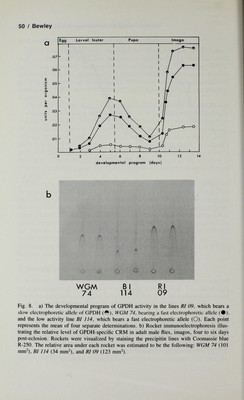
![48 / Bewiey B. Quantitative Genetic Variation of GPDH Activities GPDH activities have been measured for 50 second- and 50 third-chro¬ mosome substitution lines, and these results indicate that the lines are a rich source of quantitative variation for activity levels (Fig. 7). Relative GPDH- specific CRM levels, determined by rocket Immunoelectrophoresis, parallel the enzyme activity levels indicating differential rates of accumulation of functional GPDH molecules between lines [Laurie-Ahlberg and Bewiey, in press]. The degree of specificity of the genetic effects observed for GPDH was investigated by statistical correlations of GPDH activities with the activities of six other enzymes (catalase, CAT; alcohol dehydrogenase, ADH; aldehyde oxidase, AOX; Glucose-6-phosphate dehydrogenase, G-6PD; 6-phosphog- luconate dehydrogenase, 6-PGD; fumarase, FUM) and live weight [Laurie- Ahlberg et al, 1980]. An analysis of covariance with live weight as covariate suggested that weight variation did not account for most of the variation in activity/fly. The correlations between the genetic effects on the activities of different enzymes suggests that these effects are mainly specific for individual enzymes. Two major hypotheses concerning the genetic basis of the continuous variation observed in GPDH activities are: 1) polygenic effects—that is, that there are a large number of genetic loci on the second and third chromosomes that affect the quantitative output of the structural gene, and 2) a major gene, either structural or regulatory, with multiple alleles each affecting the quan¬ titative output of the structural gene in an additive manner. These possibilities are currently being explored by attempting to map the factor(s) responsible for the difference between extreme high and low activity lines, and by de¬ termining the manner in which these factors affect the parameters of GPDH turnover and expression at the biochemical and molecular level. C. Proximal cis-Acting Regulatory Sites A number of the second-chromosome substitution lines have been selected for a more detailed genetic and biochemical analysis (Fig. 7a). Since each line is co-isogenic with respect to genetic background, the variation observed must be due to a mutation(s) on the second chromosome only. 1. Sites controlling enzyme synthesis. Several low-activity lines that uniformly reduce the activity of both GPDH isozymes throughout develop¬ ment have been selected and compared with several high-activity lines that contain a structural element for either the slow or fast electrophoretic variant. Line BI114 expresses less than one third the enzyme activity seen in either of the high-activity control lines (Fig. 8a). Quantitative evaluation of GPDH- specific CRM by rocket immunoelectrophoresis corroborates the data ob-](https://iiif.wellcomecollection.org/image/b18019742_0069.JP2/full/800%2C/0/default.jpg)