An introduction to the old English history / comprehended in three several tracts. The first, an answer to Mr. Petyt's Rights of the commons asserted; and to a book intituled, Jani Anglorum facies nova [by William Atwood]; the second edition very much enlarged. The second, an answer to a book intituled, Argumentum antinormanicum [by Edward Cooke], much upon the same subject; never before published. The third, the exact history of the succession of the Crown of England. The second edition, also very much inlarged. Together with an appendix containing several records, and a series of great councils and parliaments before and after the conquet, unto the end of the reign of Henry the Tkhired. and a glossary expounding many words used frequently in our antient records, laws and historians...By Robert Brady.
- Robert Brady
- Date:
- 1684
Licence: Public Domain Mark
Credit: An introduction to the old English history / comprehended in three several tracts. The first, an answer to Mr. Petyt's Rights of the commons asserted; and to a book intituled, Jani Anglorum facies nova [by William Atwood]; the second edition very much enlarged. The second, an answer to a book intituled, Argumentum antinormanicum [by Edward Cooke], much upon the same subject; never before published. The third, the exact history of the succession of the Crown of England. The second edition, also very much inlarged. Together with an appendix containing several records, and a series of great councils and parliaments before and after the conquet, unto the end of the reign of Henry the Tkhired. and a glossary expounding many words used frequently in our antient records, laws and historians...By Robert Brady. Source: Wellcome Collection.
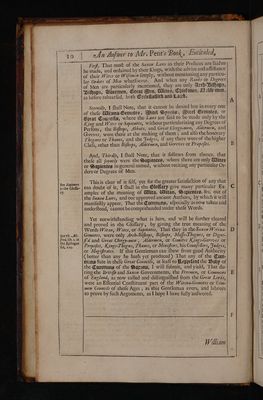
![i] a een ee A : ‘ j in the Glofla- ry. See vit. Z£I- fred, lib. 2.in the Epilogue fol, 124. eAn Anfwer to Mr. Petit’s Book , Entituled, , Firft, That moft of the Saxon Laws in their Prefaces are faidto be made, and ordained by their Kings, with the advice and affiftance of their Wites or Wifemen fimply; without mentioning any particu- lar Orders of Men whatfoever. And when any Razks or Degrees of Men are particularly mentioned, they are only Areb-Bithops, Bilhops, Aldermen, Great Men, Wiites, Chtefinen, Iosble-men, Secondly, 1 fhall Note, that it cannot be denied but in every one of thefe Witena-Gemotes, Wicel Spnade, Micel Gemates, or ®eeat Councils, where the Laws are faid to be made only by the King and Wites or Sapientes, without particularizing any Degrees of Perfons, the Bifbops, Abbats, and Great Clergy-men, Aldermen, and Gereves, were there at the making of them ; and alfo the honorary Thegnes or Thanes, and the Fudges, if any there were of the higher Clals, other than Bifbops, Aldermen, and Gereves or Prapojiti. And, Thirdly, 1 fhall Note, that it follows from thence, that thefe all joyntly were the Sapientes, where there are only Wites or Sapientes in general named, without reciting any particular Or- ders or Degrees of Men. This is clear of it felf, yet for the greater fatisfaCtion of any that can doubt of it, I fhall in the @loffarp give many particular Ex- amples of the meaning of Wita, Witan, Sapientes, &c. out of the Szxon Laws, and our approved ancient Authors, by which it will manifeftly appear, That the @ommons, efpecially asnow takenand underftood, cannot be comprehended under thofe Words. Yet notwithftanding what is here, and will be further cleared and proved in the Gloflary, by giving the true meaning of the Words Witan, Wites, or Sapientes, That they in the Saxon Witena- Gemotes, were only Arch-Bifbops, Bifhops, Maffe-Thegnes, or Digni- fid and Great Clergy-men , Aldermen, or Comites Kyugs-Gereves or or Magiftrates. If this Gentleman can fhew from good Authority (better than any he hath yet produced) That any of the €om- mong Sate in thefe Great Councils, at leaft to Repeefent the Body of the Commong of the Sarons, | will fubmit, and yield, That du- ring the Briti(b and Saxon Governments, the Freemen, or Commons of England, as now called and diftinguifhed from the Great Lords, were an Effential Conftituent part of the Wtexa-Gemotes or Com- mon Councils of thofe Ages ; as this Gentleman avers, and labours to prove by fuch Arguments, as I hope I have fully anfwered. William Be = —— ——— ee ee ee. ee eee oe. — a](https://iiif.wellcomecollection.org/image/b30335929_0030.jp2/full/800%2C/0/default.jpg)
 No text description is available for this image
 No text description is available for this image
 No text description is available for this image