Manual of diseases of the ear : including those of the nose and throat in relation to the ear : for the use of students and practitioners of medicine / by Thomas Barr and J. Stoddart Barr.
- Barr, Thomas, 1846-1916
- Date:
- 1909
Licence: In copyright
Credit: Manual of diseases of the ear : including those of the nose and throat in relation to the ear : for the use of students and practitioners of medicine / by Thomas Barr and J. Stoddart Barr. Source: Wellcome Collection.
Provider: This material has been provided by The University of Glasgow Library. The original may be consulted at The University of Glasgow Library.
63/528 (page 19)
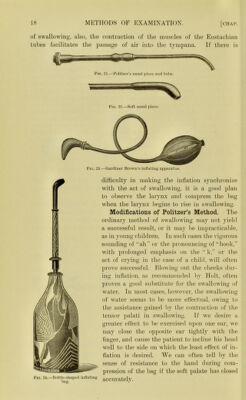
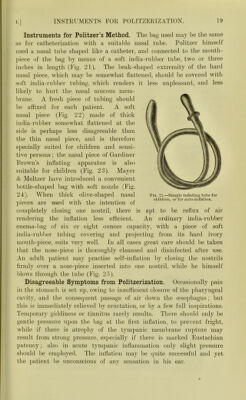
![!•] Instruments for Politzer’s Method. The bag used may be the same as for catheterization with a suitable nasal tube. Politzer himself used a nasal tube shaped like a catheter, and connected to the mouth- piece of the bag by means of a soft india-rubber tube, two or three inches in length (Fig. 21). The beak-shaped extremity of the hard nasal piece, which may be somewhat battened, should be covered with soft india-rubber tubing, which renders it less unpleasant, and less likely to hurt the nasal mucous mem- brane. A fresh piece of tubing should be affixed for each patient. A soft nasal piece (Fig. 22) made of thick india-rubber somewhat battened at the side is perhaps less disagreeable than the thin nasal piece, and is therefore specially suited for children and sensi- tive persons; the nasal piece of Gardiner Brown’s inbating apparatus is also suitable for children (Fig. 23). Mayer & Meltzer have introduced a convenient bottle-shaped bag with soft nozzle (Fig. 24). When thick olive-shaped nasal pieces are used with the intention of completely closing one nostril, there is apt to be reflux of air rendering the inbation less efficient. An ordinary india-rubber enema-bag of six or eight ounces capacity, with a piece of soft india-rubber tubing covering and projecting from its hard ivory mouth-piece, suits very well. In all cases great care should be taken that the nose-piece is thoroughly cleansed and disinfected after use. An adult patient may practise self-inbation by closing the nostrils firmly over a nose-piece inserted into one nostril, while he himself blows through the tube (Fig. 25). Disagreeable Symptoms from Politzerization. Occasionally pain in the stomach is set up, owing to insufficient closure of the pharyngeal cavity, and the consecpient passage of air down the oesophagus; but this is immediately relieved by eructation, or by a few full inspirations. Temporary giddiness or tinnitus rarely results. There should only be gentle pressure upon the bag at the first inbation, to prevent fright, while if there is atrophy of the tympanic membrane rupture may result from strong pressure, especially if there is marked Eustachian patency; also in acute tympanic inbammation only slight pressure should be employed. The inbation may be quite successful and yet the patient he unconscious of any sensation in his ear. Fig. 25.—Simple inflating tube for children, or for auto-inflation.](https://iiif.wellcomecollection.org/image/b24932577_0063.jp2/full/800%2C/0/default.jpg)