Manual of diseases of the ear : including those of the nose and throat in relation to the ear : for the use of students and practitioners of medicine / by Thomas Barr and J. Stoddart Barr.
- Barr, Thomas, 1846-1916
- Date:
- 1909
Licence: In copyright
Credit: Manual of diseases of the ear : including those of the nose and throat in relation to the ear : for the use of students and practitioners of medicine / by Thomas Barr and J. Stoddart Barr. Source: Wellcome Collection.
Provider: This material has been provided by The University of Glasgow Library. The original may be consulted at The University of Glasgow Library.
65/528 (page 21)
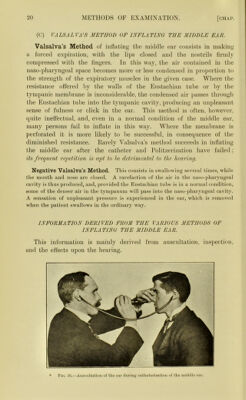
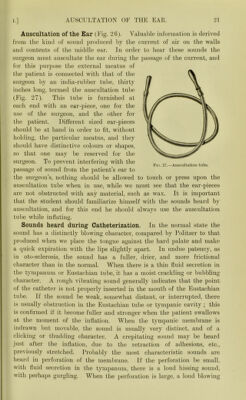
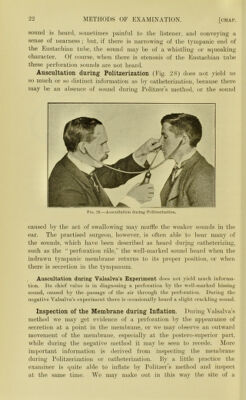
![!■] Auscultation of the Ear (Fig. 26). Valuable information is derived from the kind of sound produced by the current of air on the walls and contents of the middle ear. In order to hear these sounds the surgeon must auscultate the ear during the passage of the current, and for this purpose the external meatus of the patient is connected with that of the surgeon by an india-rubber tube, thirty inches long, termed the auscultation tube (Fig. 27). This tube is furnished at each end with an ear-piece, one for the use of the surgeon, and the other for the patient. Different sized ear-pieces should be at hand in order to fit, without holding, the particular meatus, and they should have distinctive colours or shapes, so that one may be reserved for the surgeon. To prevent interfering with the passage of sound from the patient’s ear to the surgeon’s, nothing should be allowed to touch or press upon the auscultation tube when in use, while we must see that the ear-pieces are not obstructed with any material, such as wax. It is important that the student should familiarize himself with the sounds heard by auscultation, and for this end he should always use the auscultation tube while inflating. Sounds heard during Catheterization. In the normal state the sound has a distinctly blowing character, compared by Politzer to that produced when we place the tongue against the hard palate and make a quick expiration with the lips slightly apart. In undue patency, as in oto-sclerosis, the sound has a fuller, drier, and more frictional character than in the normal. When there is a thin fluid secretion in the tympanum or Eustachian tube, it has a moist crackling or bubbling character. A rough vibrating sound generally indicates that the point of the catheter is not properly inserted in the mouth of the Eustachian tube. If the sound be weak, somewhat distant, or interrupted, there is usually obstruction in the Eustachian tube or tympanic cavity ; this is confirmed if it become fuller and stronger when the patient swallows at the moment of the inflation. When the tympanic membrane is indrawn but movable, the sound is usually very distinct, and of a clicking or thudding character. A crepitating sound may be heard just after the inflation, due to the retraction of adhesions, etc., previously stretched. Probably the most characteristic sounds are heard in perforation of the membrane. If the perforation be small, with fluid secretion in the tympanum, there is a loud hissing sound, with perhaps gurgling. When the perforation is large, a loud blowing Fio. 27.—Auscultation tube.](https://iiif.wellcomecollection.org/image/b24932577_0065.jp2/full/800%2C/0/default.jpg)