Manual of diseases of the ear : including those of the nose and throat in relation to the ear : for the use of students and practitioners of medicine / by Thomas Barr and J. Stoddart Barr.
- Barr, Thomas, 1846-1916
- Date:
- 1909
Licence: In copyright
Credit: Manual of diseases of the ear : including those of the nose and throat in relation to the ear : for the use of students and practitioners of medicine / by Thomas Barr and J. Stoddart Barr. Source: Wellcome Collection.
Provider: This material has been provided by The University of Glasgow Library. The original may be consulted at The University of Glasgow Library.
75/528 (page 31)
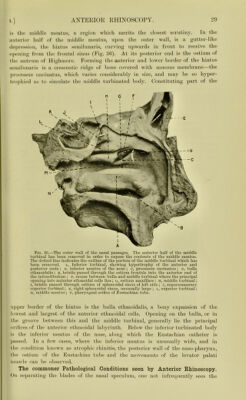
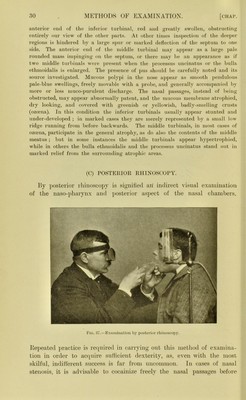
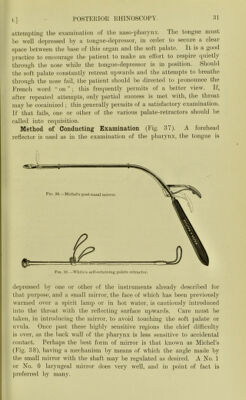
![POSTERIOR RHINOSCOPY. *•] attempting the examination of the naso-pharynx. The tongue must be well depressed by a tongue-depressor, in order to secure a clear space between the base of this organ and the soft palate. It is a good practice to encourage the patient to make an effort to respire quietly through the nose while the tongue-depressor is in position. Should the soft palate constantly retreat upwards and the attempts to breathe through the nose fail, the patient should be directed to pronounce the French word “on”; this frequently permits of a better view. If, after repeated attempts, only partial success is met with, the throat may be cocainized ; this generally permits of a satisfactory examination. If that fails, one or other of the various palate-retractors should be called into requisition. Method of Conducting Examination (Fig. 37). A forehead reflector is used as in the examination of the pharynx, the tongue is Fig. 39.—White’s self-retaining palate retractor. depressed by one or other of the instruments already described for that purpose, and a small mirror, the face of which has been previously warmed over a spirit lamp or in hot water, is cautiously introduced into the throat with the reflecting surface upwards. Care must be taken, in introducing the mirror, to avoid touching the soft palate or uvula. Once past these highly sensitive regions the chief difficulty is over, as the back wall of the pharynx is less sensitive to accidental contact. Perhaps the best form of mirror is that known as Michel’s (Fig. 38), having a mechanism by means of which the angle made by the small mirror with the shaft may be regulated as desired. A No. 1 or No. 0 laryngeal mirror does very well, and in point of fact is preferred by many.](https://iiif.wellcomecollection.org/image/b24932577_0075.jp2/full/800%2C/0/default.jpg)