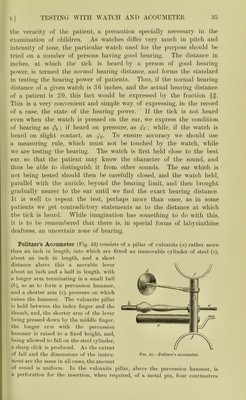
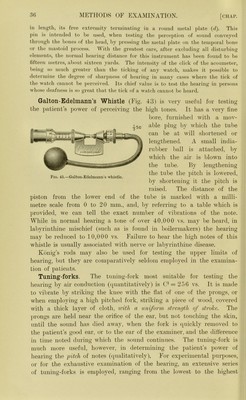
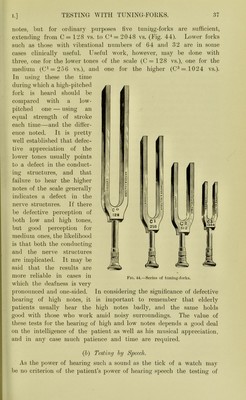
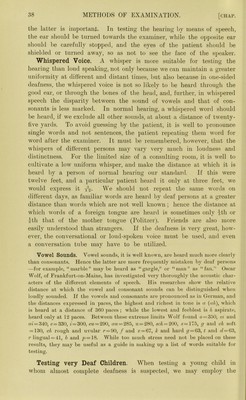
Manual of diseases of the ear : including those of the nose and throat in relation to the ear : for the use of students and practitioners of medicine / by Thomas Barr and J. Stoddart Barr.
- Barr, Thomas, 1846-1916
- Date:
- 1909
Licence: In copyright
Credit: Manual of diseases of the ear : including those of the nose and throat in relation to the ear : for the use of students and practitioners of medicine / by Thomas Barr and J. Stoddart Barr. Source: Wellcome Collection.
Provider: This material has been provided by The University of Glasgow Library. The original may be consulted at The University of Glasgow Library.
83/528 (page 39)
![!•] sound of a bell, a loud whistle, a tuning-fork, clapping the hands, or a very loud voice, taking care that the child’s face is turned away from the source of sound. We must not produce a sound by stamping on the floor or knocking: on the wall or door of the room. If a silent tuning-fork be applied to the forehead or near the ear, the child’s features will probably remain unaltered, but if applied afterwards, while vibrating, the child’s smile or cry of surprise will frequently shew that he hears the note, because there is even in deaf-mutes usually some degree of perception of sound. Simulated Deafness. The detection of simulated or exaggerated deafness is often difficult, particularly if total deafness is simulated. In continental countries, where compulsory military service exists, this form of malingering is much more common than in this country. To make the deception more easy, foreign bodies are even pressed into the ear, or caustic substances applied to the canal. An objective examina- tion should in the first place be carried out to see if there is any cause for deafness. When the person does not feign total deafness, the hearing power should be accurately tested and noted while he is blind- folded, and comparisons made at intervals, when the great disparity in the apparent hearing, as stated by the patient, who does not see how far lie hears, reveals the true state of matters. When there is feigned total deafness, it is more difficult to expose well-planned deception. Such expedients as observing if loud speech awakens the individual out of sleep, if opprobrious statements made in his presence have any effect on his features, or the effect of informing him “ to go, as he is unfit for work,” etc., may be tried. In a case under the author’s care, that of a young woman, the simulation was discovered by observing that one afternoon she sung the identical songs which had been sung by the servant in the forenoon of the same day. When we have to ascertain if total unilateral deafness exists, it is a good plan to cause the supposed malingerer to apply to his ears a double-tube stethoscope, having the tube for his hearing ear plugged. When the cup-shaped end of the stethoscope is spoken into, the person will probably say he hears. If the tube is now removed from the hearing ear, and the latter closed with the finger, he will say that he no longer hears, knowing as lie does that the hearing ear is shut, while the tube of the stethoscope is only in the ear in which he pretends to be deaf. (B) TESTS APPLIED BY BONE-CONDUCTION. Bone-Conduction of Sound. Supposing the ears were sealed up so that a vibrating tuning-fork could not be heard by air-conduction, if the fork were placed in contact with the head, its note would be heard resounding even more loudly than if the ears were open.](https://iiif.wellcomecollection.org/image/b24932577_0083.jp2/full/800%2C/0/default.jpg)