[Report 1938] / Medical Officer of Health, Middlesbrough County Borough.
- Middlesbrough (England). County Borough Council.
- Date:
- 1938
Licence: Attribution 4.0 International (CC BY 4.0)
Credit: [Report 1938] / Medical Officer of Health, Middlesbrough County Borough. Source: Wellcome Collection.
46/132 page 44
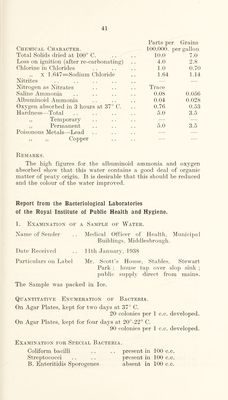
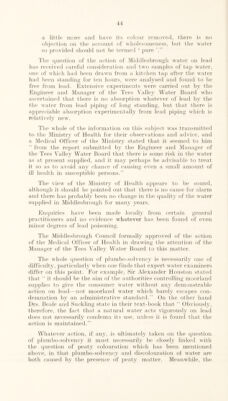
![cl little more and liave its colour removed, there is no objection on the account of wholesomeness, but the water so ])rovided should not be termed ‘ })nre The question of the action of Middlesbrough water on lead has received careful consideration and two sani])les of taj) water, one of which had been dravui from a kitchen taj) after the water had been standintjj for ten hours, were analysed and found to be free from lead. Extensive experiments were carried out by the Engineer and Manager of the Tees \hilley Water Board who ascertained that there is no absorption whatever of lead by the the water from lead piping of long standing, but that there is a})|)reciable absorption experimentally from lead ])iping which is relatively newo The whole of the information on this subject wms transmitted to the Ministr} of Health for their observations and advice, and a Medical Officer of the Ministry stated that it seemed to him “ from the report submitted by the Engineer and Manager of the Tees Valley Water Board that there is some risk in the water as at ]:>resent su]:)plied, and it may perhaps be advisable to treat it so as to avoid any chance of causing even a small amount of ill health in susceptible persons.” The view of the Ministry of Health appears to be sound, although it should be pointed out that there is no cause for alarm and there has probably been no change in the quality of the water supplied in Middlesbrough for many years. Enquiries have been made locally from certain general practitioners and no evidence whatever has been found of even minor degrees of lead poisoning. The Middlesbrough Council formally approved of the action of the Medical Officer of Health in drawing the attention of the Manager of the Tees Valley Water Board to this matter. The whole question of plumbo-solvency i« necessarily one of difficulty, particularly when one finds that expert water examiners differ on this point. For example. Sir Alexander Houston stated that “ it should be the aim of the authorities controlling moorland snp|)lies to give the consumer water without any demonstrable action on lead—not moorland water which barely esca])es con¬ demnation by an administrative standard.” On the other hand l)rs. Beale and Suckling state in their text-book that “ Obviously, therefore, the fact that a natural water acts vigorously on lead does not necessarily condemn its use, unless ifc is found that the action is maintained.” Whatever action, if any, is vdtimately taken on the ({uestion of plumbo-solvency it must necessarily be closely linked with the question of peaty colouration which has been mentioned above, in that plumbo-solvency and discolouration of water are both caused by the presence of peaty matter. Meanwhile, the](https://iiif.wellcomecollection.org/image/b29797706_0046.jp2/full/800%2C/0/default.jpg)



 No text description is available for this image
 No text description is available for this image
 No text description is available for this image