Correspondence with T. Spencer Wells... on ovariotomy.
- Wells Spencer, 1818-1897.
- Date:
- 1882
Licence: Public Domain Mark
Credit: Correspondence with T. Spencer Wells... on ovariotomy. Source: Wellcome Collection.
Provider: This material has been provided by the Royal College of Physicians of Edinburgh. The original may be consulted at the Royal College of Physicians of Edinburgh.
34/41 page 34
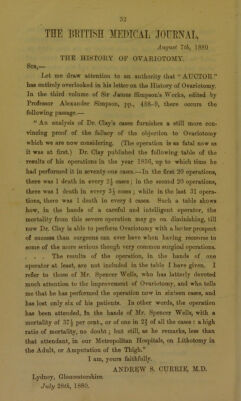
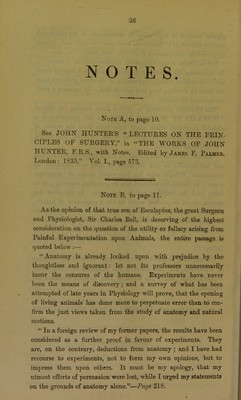
![high scientific attainments, and who is deservedly held in great repute in human medicine. This gentleman is, and has been, a renowned experimenter on Animals, and should, therefore, be expected to know som’ething about them. ... In the few allusions I am about to make it will be seen how inapplicable certain doctrines which find favour in human medicine, are, when applied to that of the lower Animals. . . . He (Dr. Hichard- son) says, in reference to the contagious principles or elements of disease;—‘ As regards the organic poisons themselves and their physical properties, I would, in the first place, point out that the great type of them all is represented by the poison of any poisonous snake. If I were going to speak of a family of plants, or a family of men, or a family of animals, I should take one great type, and then describe from that; and in presenting to your minds an idea of the organic poisons which produce the spreading diseases, I take the poison which is in the poison-bag of a poisonous snake, . . . It is the great type of all the poisons which produce disease.’ ” “ Surely (observes ‘ THE VETERINARIAN') this is a mis- take; or, if not, the comparison would never hold good in Vetern nary medicine. Snake poison is a healthy secretion;—the virus of a contagious disease, at least in the lower Animals, is the product of a morbid state;—a certain and appreciable quantity of snake poison is required to produce its effects in a marked form, and the animal so afiected has not the power to afifect another ;—the virus of a contagious malady, on the contrary, if introduced into the body of a creature, no matter in how small a quantity, has yet the (we might term it vital) property of inducing a like malady to that which produced it, and so on through any number of animals under certain circumstances. , . . The poison of snake-bite, or the poison of any venomous animal no more resembles that of a contagious disease than does the active principle of opium or tobacco resemble the vaccine virus or the contagion of cattle plague. There is no analogy or typical resemblance whatever, the Veterinarian would say.” . . . “ It is (asserts Dr. Richardson) also clear that Animals give us disease. For imtance, the disease sincdl-pox is cminected toith the disease of the horse called farcy. . . . “ What is the meaning of this] (says ‘THE VETERINARIAN.’) It takes one’s breath away ! Farcy and small-pox connected ! What has the](https://iiif.wellcomecollection.org/image/b21704053_0036.jp2/full/800%2C/0/default.jpg)



 No text description is available for this image
 No text description is available for this image
 No text description is available for this image