An essay on the physiology of the iris : with a different view of its relations and sympathies from the one usually received : and an attempt to establish a new theory of the action of light upon the eye / by John Walker.
- John Walker
- Date:
- 1833
Licence: Public Domain Mark
Credit: An essay on the physiology of the iris : with a different view of its relations and sympathies from the one usually received : and an attempt to establish a new theory of the action of light upon the eye / by John Walker. Source: Wellcome Collection.
Provider: This material has been provided by The University of Glasgow Library. The original may be consulted at The University of Glasgow Library.
6/20 page 4
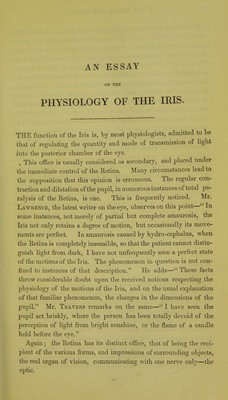
![If it be supposed to be the dictator to the Iris, as to how much or how little light is to be admitted through its aperture, then it would require a separate nerve for this purpose; as it is contrary to all analogy for one nerve to be subservient to two distinct ends. The obscurity, which exists on these points, is occasioned by con- founding these two very different functions, the reception of images for transmission through the optic nerve to the brain, which is the function of the Retina,—and sensibility to light, which is common to the Iris and the external parts of the eye generally, and which is derived from their connexion with the fifth nerve. If this distinc- tion be kept in view, all difficulty will cease: without it there is no satisfactory way of explaining the phenomena of vision and the sen- ] sibility and mobility of the Iris. How otherwise can we account for the state of the pupil in sleep ? Then no light gets to the Eetina, ' and yet the pupil is contracted. It has been ascertained that the Iris may be paralyzed and ren- dered motionless without a corresponding insensibility of the Retina. Instances of this are related by Mr. Lawrence, at the same itime he expresses his inability to explain the phenomenon. Others have been mentioned to me, by my colleagues, as having occurred in their practice. In these cases, instead of there being paralysis of the Retina, there was loss of power of those muscles of the eye which are supplied by the third nerve—the motor oculi. This can only be explained on the supposition of their mutual independence of each other. That there is this independent action of the Iris, and external parts of the eye generally, will appear also from a consideration of certain excited states of the organ. , The inflammation of the external tunics, attended, as it usually is, with intolerance of light, and a contracted state of the pupil, where the Retina is totally unaffected, except, as it is expressed, from sym- pathy, affords a strong presumption of this. How, it may be asked, can there be increased or morbid sensibility to light where there is no previous natural sensibility ? Where is thp connecting medium between the sympathizing Retina and the exterior of the eye ? The Retina and Optic nerve have no immediate nervous communication with the Iris or external parts of the eye ; their functions being of a dilFerent order, and confined to the one all-important and paramount](https://iiif.wellcomecollection.org/image/b21474588_0006.jp2/full/800%2C/0/default.jpg)