Volume 1
The Natural history of man : comprising inquiries into the modifying influence of physical and moral agencies on the different tribes of the human family / by James Cowles Prichard, M.D. F.R.S. M.R.I.A., President of the Ethnological Society, corresponding member of the National Institute, and of the Royal Academy of Medicine, and of the Statistical Society, of France, member of the American Philosophical Society; etc.
- James Cowles Prichard
- Date:
- 1855
Licence: Public Domain Mark
Credit: The Natural history of man : comprising inquiries into the modifying influence of physical and moral agencies on the different tribes of the human family / by James Cowles Prichard, M.D. F.R.S. M.R.I.A., President of the Ethnological Society, corresponding member of the National Institute, and of the Royal Academy of Medicine, and of the Statistical Society, of France, member of the American Philosophical Society; etc. Source: Wellcome Collection.
Provider: This material has been provided by Royal College of Physicians, London. The original may be consulted at Royal College of Physicians, London.
403/414
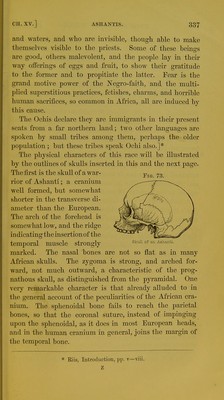
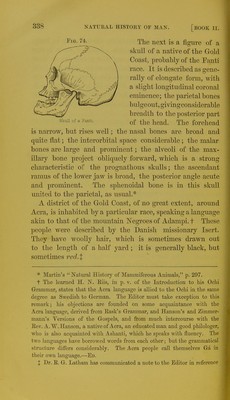
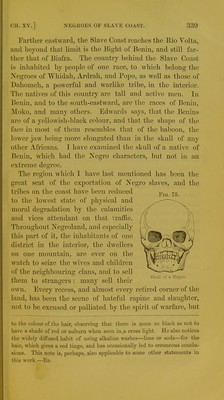
![and waters, and who are invisible, though able to make themselves visible to the priests. Some of these beings are good, others malevolent, and the people lay in their way oflPerings of eggs and fruit, to show their gratitude to the former and to propitiate the latter. Pear is the grand motive power of the Negro-faith, and the multi- plied superstitious practices, fetishes, charms, and horrible human sacrifices, so common in Africa, all are induced by this cause. The Ochis declare they are immigrants in their present seats from a far northern land; two other languages are spoken by small tribes among them, perhaps the older population; but these tribes speak Ochi also.]* The physical characters of this race will be illustrated by the outlines of skulls inserted in this and the next page. The first is the skull of a war- yg rior of Ashanti; a cranium well formed, but somewhat shorter in the transverse di- ameter than the European. The arch of the forehead is somewhat low, and the ridge indicating the insertion of the temporal muscle strongly °^ Ashanti. marked. The nasal bones are not so flat as in many African skulls. The zygoma is strong, and arched for- ward, not much outward, a characteristic of the prog- nathous skull, as distinguished from the pyramidal. One very remarkable character is that already alluded to in the general account of the peculiarities of the African cra- nium. The sphenoidal bone fails to reach the parietal bones, so that the coronal suture, instead of impinging upon the sphenoidal, as it does in most European heads, and in the human cranium in general, joins the margin of the temporal bone. * Eiis, Introduction, pp. t—viii. Z](https://iiif.wellcomecollection.org/image/b22652140_0421.jp2/full/800%2C/0/default.jpg)
 No text description is available for this image
 No text description is available for this image
 No text description is available for this image