Club-foot : its causes, pathology, and treatment. Being the essay to which the Jacksonian Prize for 1864, given by the Royal College of Surgeons, was awarded / by William Adams.
- Adams, William
- Date:
- 1866
Licence: Public Domain Mark
Credit: Club-foot : its causes, pathology, and treatment. Being the essay to which the Jacksonian Prize for 1864, given by the Royal College of Surgeons, was awarded / by William Adams. Source: Wellcome Collection.
Provider: This material has been provided by UCL Library Services. The original may be consulted at UCL (University College London)
430/452 (page 406)
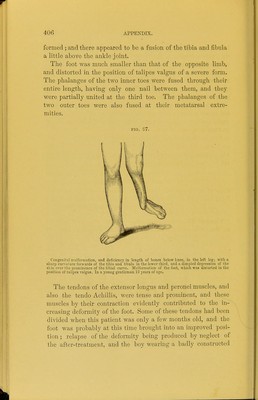
![formed; and there appeared to be a fusion of the tibia and fibula a little above the ankle joint. The foot was much smaller than that of the opposite limb, and distorted in the position of talipes valgus of a severe form. The phalanges of the two inner toes were fused through their entire length, having only one nail between them, and they were partially united at the third toe. The phalanges of the two outer toes were also fused at their metatarsal extre- mities. Congeiiiliil malformation, and deficiency in length of bones below knee, in the left leg; with a sharp cui viM lire forwards of the tibia and fibula in the lower third, and a dimpled depression of the skii] over the prominence of the tibial curve. Malformation of the foot, which was distorted in the position of talipes valgus. In a young gentleman 13 years of age. The tendons of the extensor longus and peronei muscles, and also the tendo Achillis, were tense and prominent, and these muscles by their contraction evidently contributed to the in- creasing deformity of the foot. Some of these tendons had been divided when this patient was only a few months old, and the foot was probably at this time brought into an improved posi- tion ; relapse of the deformity being produced by neglect of the after-treatment, and the boy wearing a badly constructed no. G7.](https://iiif.wellcomecollection.org/image/b2128944x_0430.jp2/full/800%2C/0/default.jpg)