Serums, vaccines and toxines in treatment and diagnosis / by Wm. Cecil Bosanquet ... and John W.H. Eyre.
- William Cecil Bosanquet
- Date:
- 1909
Licence: In copyright
Credit: Serums, vaccines and toxines in treatment and diagnosis / by Wm. Cecil Bosanquet ... and John W.H. Eyre. Source: Wellcome Collection.
Provider: This material has been provided by The University of Leeds Library. The original may be consulted at The University of Leeds Library.
17/380 (page 5)
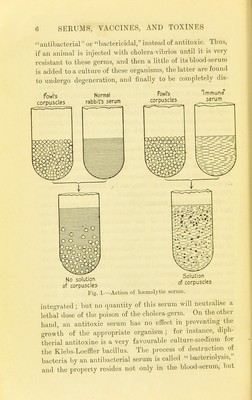
![appropriate toxine. Similarly, in the case of snake-venom an antitoxic serum was prepared, of which use has been made therapeutically with some degree of success. Chemical nature of antitoxines.—Examination of the blood of horses used for the preparation of diphtherial antitoxine shows that the globulin-content of the serum is increased.1 Further, if the antitoxic serum obtained from them is fractionally precipitated with ammonium sulphate, it is found that the antitoxine is precipitated with the pseudo-globulin2—that portion which is thrown clown by semi-saturation with the salt. In animals other than horses {e.g. goats) the antitoxine may be thrown down with the euglobulin precipitate. Hence it has been in- ferred that the antitoxine is a globulin. This cannot be regarded as definitely proved, since substances are often carried down with precipitates from which they are chemically distinct (e.g. ferments). Proescher3 believes that antitoxines are non-albuminous. Antibacterial Serum.—It may here be pointed out that in order to prepare an antitoxic serum it is necessary to obtain the toxine of the bacterium in question for the purpose of injection into animals. In the case of diphtheria and tetanus this was easily done. In the case of many organisms, however, difficulties arise, since their poison is not secreted into culture-media, but remains in the bodies of the bacteria themselves. If the actual terras are injected into animals, beginning with minute doses of attenuated cultures and gradually increasing until large quantities of virulent bacteria can be tolerated, in most cases a serum is produced which is not antitoxic in the sense of neutralising the poisons of the micro-organism, but which destroys the bacteria themselves when they are submitted to its action. Such a serum is said to be 1 This is denied by Lcdingham. Joiirn. of Hygiene, 1907, vii. 05,92. 2 Pick, Hofmeiiter'a Beitr., 190], p. 1384. ;i Miineh. mod. Woch., 1002, p. 1176.](https://iiif.wellcomecollection.org/image/b21507594_0017.jp2/full/800%2C/0/default.jpg)