Digest of the English census of 1871 / compiled from the official returns and edited by James Lewis.
- Great Britain. Census Office.
- Date:
- 1873
Licence: Public Domain Mark
Credit: Digest of the English census of 1871 / compiled from the official returns and edited by James Lewis. Source: Wellcome Collection.
27/238 page 13
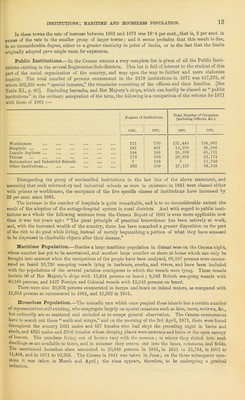
![institutions; maritime and houseless population. In these towns the rate of increase between 1861 and 1871 was 18 ’4 per cent., that is, 2 per cent, in excess of the rate in the smaller group of larger towns ; and it seems probable that this result is due, in no inconsiderable degree, either to a greater elasticity in point of limits, or to the fact that the limits originally adopted gave ample room for expansion. Public Institutions.—In the Census returns a very complete list is given of all the Public Insti- tutions existing in the several Registration Sub-districts. This list is full of interest to the student of this part of the social organization of the country, and may open the way to further and more elaborate inquiry. The total number of persons enumerated in the 2479 institutions in 1871 was 417,579, of whom 362,295 were “ special inmates,” the remainder consisting of the officers and their families. [See liable XI., p. 60]. Excluding barracks, and Her Majesty’s ships, which can hardly be classed as “ public institutions” in the ordinary acceptation of the term, the following is a comparison of the returns for 1871 with those of 1861 :— Number of Institutions. Total Number of Occupants (including Officers, &c.). 1861. 1871. 1861. 1871. Workhouses 721 730 131,440 154,967 Hospitals ... ... 167 407 13,200 26,566 Lunatic Asylums ... • • • 144 166 29,198 45,731 Prisons • • • 179 149 29,959 32,174 Reformatory and Industrial Schools • • • ? 118 ? 11,748 Other Institutions... • • • 282 559 27,157 38,535 Disregarding the group of unclassified institutions in the last line of the above statement, and assuming that such reformatory and industrial schools as were in existence in 1861 were classed either with prisons or workhouses, the occupants of the five specific classes of institutions have increased by 33 per cent, since 1861. The increase in the number of hospitals is quite remarkable, and is to no inconsiderable extent the result of the adoption of the cottage-hospital system in rural districts. And with regard to public insti- tutions as a whole the following sentence from the Census Report of 1861 is even more applicable now than it was ten years ago: “ The great principle of practical benevolence has been actively at work, and, with the increased wealth of the country, there has been remarked a greater disposition on the part of the rich to do good while living, instead of merely bequeathing a portion of what they have amassed to be dispensed in charitable objects after their decease.” Maritime Population.—Besides a large maritime population in distant seas on the Census night, whose number has yet to be ascertained, and another large number on shore at home which can only be brought into account when the occupations of the people have been analysed, 66,187 persons were enume- rated on board 10,726 sea-going vessels lying in harbours, creeks, and rivers, and have been included with the populations of the several parishes contiguous to which the vessels were lying. These vessels include 96 of Her Majesty’s ships with 13,454 persons on board ; 9,193 British sea-going vessels with 40,188 persons, and 1437 Foreign and Colonial vessels with 12,545 persons on board. There were also 10,976 persons enumerated in barges and boats on inland waters, as compared with 11,915 persons so enumerated in 1861, and 12,562 in 1851. Houseless Population.—The nomadic race which once peopled these islands has a certain number of representatives still existing, who congregate largely on special occasions such as fairs, races, reviews, &c., but ordinarily are so scattered and secluded as to escape general observation. The Census enumerators have to search out these “ waifs and strays,” and on the morning of the 3rd April, 1871, there were found throughout the country 1921 males and 437 females who had slept the preceding night in barns and sheds, and 4325 males and 3700 females whose sleeping places were caravans and tents or the open canopy of heaven. The numbers living out of houses vary with the seasons ; in winter they shrink into such dwellings as arc available to them, and in summer they swarm out into the lanes, commons, and fields, dhe ascertained houseless class amounted to 20,348 persons in 1841, in 1851 io 15,764, in 1861 to 11,444, and in 1871 to 10,383. The Census in 1841 was taken in June; on the three subsequent occa- sions it was taken in March and April; the class appears, therefore, to be undergoing a gradual reduction.](https://iiif.wellcomecollection.org/image/b2810724x_0027.jp2/full/800%2C/0/default.jpg)
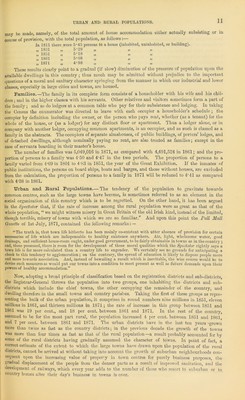
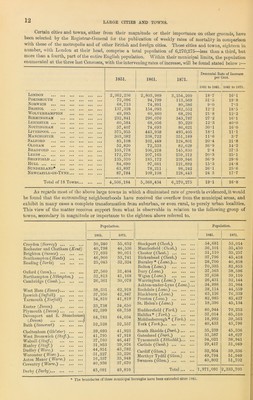
 No text description is available for this image
 No text description is available for this image
 No text description is available for this image