The constituents of the bark of Prunus serotina : [isolation of 1-mandelonitrile glucoside] / by Frederick B. Power and Charles W. Moore.
- Frederick Belding Power
- Date:
- [1909]
Licence: Attribution 4.0 International (CC BY 4.0)
Credit: The constituents of the bark of Prunus serotina : [isolation of 1-mandelonitrile glucoside] / by Frederick B. Power and Charles W. Moore. Source: Wellcome Collection.
Provider: This material has been provided by The Royal College of Surgeons of England. The original may be consulted at The Royal College of Surgeons of England.
4/22 page 244
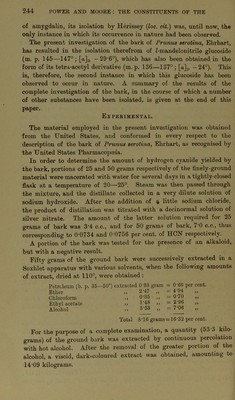
![of amygdalin, its isolation by Herissey (loc. cit.) was, until now, the only instance in which its occurrence in nature had been observed. The present investigation of the bark of Prunus serotina, Ehrhart, has resulted in the isolation therefrom of Z-mandelonitrile glucoside (m. p. 145—147°; [a]D - 29,6°), which has also been obtained in the form of its tetra-acetyl derivative (m. p. 136—137° ; [a]D - 24°). This is, therefore, the second instance in which this glucoside has been observed to occur in nature. A summary of the results of the complete investigation of the bark, in the course of which a number of other substances have been isolated, is given at the end of this paper. Experimental. The material employed in the present investigation was obtained from the United States, and conformed in every respect to the description of the bark of Prunus serotina, Ehrhart, as recognised by the United States Pharmacopoeia. In order to determine the amount of hydrogen cyanide yielded by the bark, portions of 25 and 50 grams respectively of the finely-ground material were macerated with water for several days in a tightly-closed flask at a temperature of 20—25°. Steam was then passed through the mixture, and the distillate collected in a very dilute solution of sodium hydroxide. After the addition of 9. little sodium chloride, the product of distillation was titrated with a decinormal solution of silver nitrate. The amount of the latter solution required for 25 grams of bark was 3‘4 c.c., and for 50 grams of bark, 1 '0 c.c., thus corresponding to 0'0734 and 0'0756 per cent, of HCN respectively. A portion of the bark was tested for the presence of an alkaloid, but with a negative result. Fifty grams of the ground bark were successively extracted in a Soxhlet apparatus with various solvents, when the following amounts of extract, dried at 110°, were obtained : Petroleum (b. p. Ether Chloroform Ethyl acetate Alcohol 35—50°) extracted 0'33 gram = 0'66 per cent. „ 2-47 „ = 4-94 „ „ 0-35 „ = 070 „ 1-48 „ = 2-96 3-53 „ = 7-06 Total 8T6 grams = 16-32 per cent. For the purpose of a complete examination, a quantity (53 3 kilo- grams) of the ground bark was extracted by continuous percolation with hot alcohol. After the removal of the greater portion of the alcohol, a viscid, dark-coloured extract was obtained, amounting to 14-09 kilograms.](https://iiif.wellcomecollection.org/image/b22425135_0006.jp2/full/800%2C/0/default.jpg)