A contribution to the pharmacognosy of official strophanthus seed : read before the British Pharmaceutical Conference in London, July 1900 / by Pierre Élie Félix Perrédès.
- Perrédès, Pierre Élie Félix.
- Date:
- [1900]
Licence: Attribution 4.0 International (CC BY 4.0)
Credit: A contribution to the pharmacognosy of official strophanthus seed : read before the British Pharmaceutical Conference in London, July 1900 / by Pierre Élie Félix Perrédès. Source: Wellcome Collection.
3/48 (page 1)
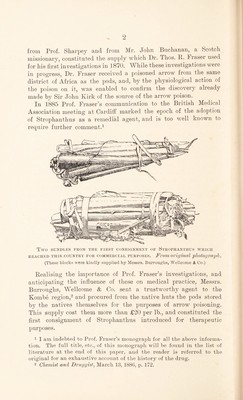
![A CONTRIBUTION TO THE PHARMACOGNOSY OF OFFICIAL STROPHANTHUS SEED. By PIERRE ELIE FELIX PERREDES, Pharniaceutical Chemist. Historical Eesume of the ^^Kombe” Drug up to the Time OF ITS Introduction into Medical Practice, The discovery, in 1861, of the plant yielding the ‘M'lombe ” poison is due to Sir John Kirk, and has been described by him in the following words:—The source of the poison, namely, Strc- phanthus Kombd^ was first identified by me. I had long sought for it, but the natives invariably gave me some false plant, until one day at Chibisa’s village, on the river Shire, I saw the ^Kombe,’ then new to me as an East African plant (I had known an allied, or perhaps identical, species at Sierra Leone [1858], where it is used as a poison). There climbing on a tall tree it was in pod, and I could get no one to go up and pick specimens. On mounting the tree myself to reach the Kombe pods, the natives, afraid that I might poison myself if I handled the plant roughly or got the juice in a cut or in my mouth, warned me to be careful, and admitted that this was the ^ Kombe ’ or poison plant. In this way the poison was identified, and I brought specimens home to Kew, where they were described.” ^ The Kev. Horace Waller, who, like Sir John Kirk, was associated with Bishop Mackenzie’s missionary expedition of 1861-64, also obtained some pods from a native chief in 1863, and these were brought to England by Sir John Kirk in the same year. With these pods the first physiological experiments were made, by Dr. Sharpey in 1862-63, and by Messrs. Hilton Eagge, and Stevenson in 1865. These experimenters found that the Kombe arrow poison acted as a cardiac poison. In 1869 the Rev. Horace Waller presented some specimens of ripe pods to the Materia Medica Museum of the Luiversity of Edinburgh, and these, together with additional material obtained ^ Subsequent investigations have shewn that the “ Kombe ” seeds of commerce are probably derived from several species of Strophanthus, but the question is too much involved to be discussed here. Suffice it to say tliat, up to the present, no seeds have been obtained which are positively known to have been gathered from the plant tStropliatithua Kombe (Oliver).](https://iiif.wellcomecollection.org/image/b29008153_0003.jp2/full/800%2C/0/default.jpg)