Chemical examination of the root of Ipomoea orizabensis / by Frederick B. Power and Harold Rogerson.
- Frederick Belding Power
- Date:
- 1912
Licence: In copyright
Credit: Chemical examination of the root of Ipomoea orizabensis / by Frederick B. Power and Harold Rogerson. Source: Wellcome Collection.
Provider: This material has been provided by The Royal College of Surgeons of England. The original may be consulted at The Royal College of Surgeons of England.
20/32 (page 16)
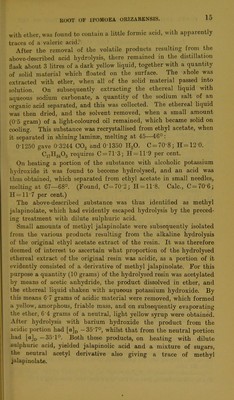
![Isolation of Jalapinolic Acid, Ci6Hm(OH),CX)2B[. (Hydroxyhexadecylic Acid.) The sodium salt, obtained by extracting the ethereal liquid with sodium carbonate, as above described, was decomposed with dilute sulphuric acid, and the liberated organic acid taken up with ether. On removing the solvent, a quantity (62 grams) of an oily product was obtained, which solidified on cooling to a crystalline mass. This was dissolved in alcohol, mixed with purified sawdust, and the thoroughly dried mixture extracted successively with (a) light petroleum, and (b) ether. (a) Petroleum Extract.—This was a white, fatty mass, amounting to 48 grams. It was converted into the methyl ester by dissolving in methyl alcohol and saturating the solution with dry hydrogen chloride. On subsequently pouring the acid liquid into water, and extracting with ether, a product was obtained, which, when distilled under diminished pressure, passed over at 220°/20 mm. as a colourless oil, and, on cooling, solidified to a white, crystalline mass. On recrystallising the distilled ester from ethyl acetate, it separated in handsome laminse, melting at 47—49°. (Found, C = 71'0; H = 11’9. Calc., C = 7T3; H = 1T9 per cent.) The optical rotatory power of the ester was determined, with the following result: 2'8756, made up to 20 c.c. with chloroform, gave oD +0°17/ in a 2-dcm. tube, whence [a]D +0 98°. The ester was then hydrolysed by boiling with an alcoholic solution of potassium hydroxide, the alcohol removed, and the liquid acidi- fied, when an acid was obtained, which separated from dilute acetic acid in fine, silky needles, melting at 67—68°. (Found, C = 70'7; H = 1T8. Neutralisation value = 209'3. Calc., C = 70'6; H = 11'7 per cent. Neutralisation value = 206‘2.) The above-described acid is thus seen to be jalapinolic acid, a compound which was first obtained by Mayer from “ jalapin ” (Annalen, 1855, 95, 149), and subsequently investigated by Kromer (/. pr. Chcm., 1898, [ii], 57, 448). The lastrmentioned investigator stated that jalapinolic acid is optically inactive, which is not correct, although its rotatory power is comparatively small *: * Having observed the optical activity of jalapinolic acid, it seemed desirable to examine in this respect two other hydroxy-acids which had previously been obtained from convolvulaceous resins, namely: convolvulinolic acid (/. Aintr. Chcm. Soc., 1910, 32, 106) and ipurolic acid, (ibid., p. 107, and Amer. J. Pharm., 1008, 80, 273). Convolvulinolic acid, C14H28(0H),C0.1H (m. p. 61—52°): 4T738, made up to 20 c.c. with chloroform, gave a„ + Q°35' in a 2‘dcrn. tube, whence [a]u + r39°.](https://iiif.wellcomecollection.org/image/b22439250_0020.jp2/full/800%2C/0/default.jpg)