Volume 1
Surgery : its principles and practice / by various authors ; edited by William Williams Keen.
- Date:
- 1907-1913
Licence: Attribution-NonCommercial 4.0 International (CC BY-NC 4.0)
Credit: Surgery : its principles and practice / by various authors ; edited by William Williams Keen. Source: Wellcome Collection.
979/1036 (page 935)
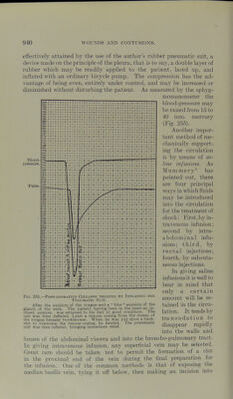
![drainage may be made. After the acute stage has passed, under gas or gas and ether, better drainage may be proAuded or further indicated measures may be executed. The same plan may be advantageously employed in pelvic and ap- pendiceal abscesses. That is to say, operative treatment by a process of physiologic progression is not infrequently necessary. In operations on the pelvic organs we are impressed with the fact that this area is somewhat less shock-producing than equally extensive dissections above the pelvis. Extremities.—The prevention of shock in operations upon the ex- tremities has resolved itself into three simple propositions—the minimum loss of blood, the minimum manipulation and force, and the blocking” of the nerve-trunks by intraneural injections of 10 or 15 minims of a 2 per cent, solution of cocain and eucain. In considering the first proposition, surgeons will succeed by individual methods. For some time I have adopted the plan of direct dissection, using for the soft parts precisely the same instruments as for a breast amputation. The smaller vessels are secured in passing and a dry field is maintained. The large nerve-trunks are exposed as early as possible and blocked.” The larger vessels are ligated and divided as they are reached. Great care is exercised in so dividing the tissues that no further revision is required. The bone is divided by means of a Gigli saw, obviating the heavy manqDulation of retraction of the entire stump when a plain saw is used. As an example, in interscapulo-humeral amputations by first exposing the subclavian artery and vein and the brachial plexus through the same incision each trunk of the plexus is blocked”; the artery and vein are then secured and the skin incision of the part supplied by the cervical nerves is made. The anesthetic may now be withdraAvn, as the major field remaining has been anesthetized and rendered immune from shock by the physiologic blocking” of the brachial plexus. As no impulses of any kind can pass either upward or downward there is no more shock in dividing the tissues, even the nerve-trunks thus blocked,” than in dividing the sleeve of the patient’s coat. Wainwright “ has recently added important evidence of the value of spinal anesthesia in the prevention of shock in amputations of the lower extremities, from both the clinical and the experimental standpoint. Blood-pressure ob.servations l)y means of a sphygmomanometer during such operations entirely substantiate this statement (Fig. 252). However, after the effect of the block” wears away, impulses then pass up from the injured nerves, just as after am])utation by any other method, but the va.somotor centers have been })rotccted against their greatest dangers and can better tide over the crisis. Summary.— Every tissue and organ has a more or loss individual shock-producing value and must l)e individually considered. The amount of shock produced by a given trauma varies according to the quantity and the special quality of the nerve-sui)ply of the tissue involved and the](https://iiif.wellcomecollection.org/image/b2811968x_0001_0979.jp2/full/800%2C/0/default.jpg)