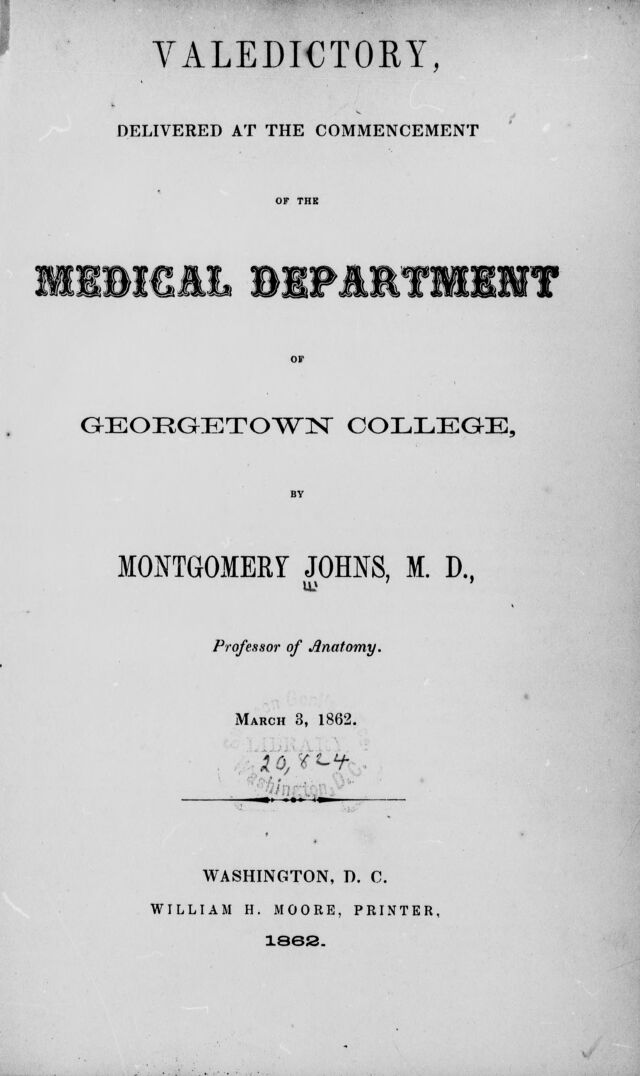
Valedictory, delivered at the commencement of the Medical Department of Georgetown College : March 3, 1862 / by Montgomery Johns.
- Johns, Montgomery, -1871.
- Date:
- 1862
Licence: Public Domain Mark
Credit: Valedictory, delivered at the commencement of the Medical Department of Georgetown College : March 3, 1862 / by Montgomery Johns. Source: Wellcome Collection.
Provider: This material has been provided by the National Library of Medicine (U.S.), through the Medical Heritage Library. The original may be consulted at the National Library of Medicine (U.S.)
17/24
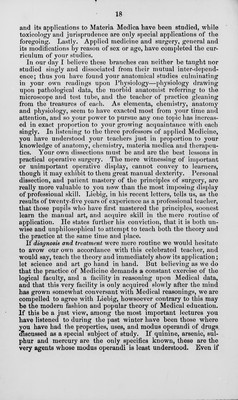
![The traveller who enters the indescribably perfect, though un- finished cathedral at Cologne, learns a never to be forgotten les- son of humility and faith. So gentlemen would I have you enter the venerable and magnificent temple of Medical truth, reared by the labor of many centuries, unfinished though it be; these same lessons of humility and of faith well befit you as you stand before its august portals; succeeding generations may find it, as well as Cologne's,majestic gothio masonry, incomplete, unfinished in some of its details: it is our business, if we bring but one well polished stone, to do our share to embellish and complete that which has been advancing toward completion during so many ages. In our day genuine Medical philosophy bends to no Procrus- tean system, belongs to no sect, has no exclusive dogmas. As in philosophy, the best minds of our day advocate a rational eclee- tieism in intellectual and moral reasoning, so in Medicine, Paget, Latham, Trousseu, Simon, and Wood labor to establish truth on the basis of sound, accurate, impartial observation. Knew we nought else in Medicine, to adopt the rude language of Cotton Mather, we have learned at least to distinguish things knowable from things impossible to be found out, a no mean acquisition: we can put our finger upon the dividing line where our knowl- edge ends and our ignorance begins, in many portions of Medi- cal science. Though the microscope is wondrously improved in its optical construction, the histologist acknowledges a terra incognita in his domain, notwithstanding the tact and patience of hundreds of observers. Perfect as is analytical chemistry and the theory of the science, the physiologist admits he cannot give a complete history of functional agencies. Even the anatomist, aided by these and by the embryologist and comparative inquirer, lays aside the scalpel with a sigh, when he examines the thymus and prostate glands, the supra renal capsules, the sympathetic nerve, or the intricate tracery of ascending, transverse and longitudinal fibres of the Brain. With this view of the present; position of our science and of our art, we can now profitably take a rapid glance in retrospect over our occupations during the past winter, having thus defined Medical science, the sources of its improvement, its modes of legitimate investigation, and the relative importance of its several auxiliary and collateral sciences. With these views your attention has been directed to anatomy, genera], demonstrative and microscopic; to the physiological re- lations of chemistry and to special physiology; these, with Hy- giene, include the doctrine of man in health. Secondly. The pa- thologist has laid before you pathology, both gross and microsco- pic, also, the chemistry of diseased actions. Thirdly. Chemistry 3](https://iiif.wellcomecollection.org/image/b21133578_0017.jp2/full/800%2C/0/default.jpg)