The social and national influence of the domiciliary condition of the people : three addresses / by Robert Rawlinson.
- Robert Rawlinson
- Date:
- 1883
Licence: Public Domain Mark
Credit: The social and national influence of the domiciliary condition of the people : three addresses / by Robert Rawlinson. Source: Wellcome Collection.
92/108 page 80
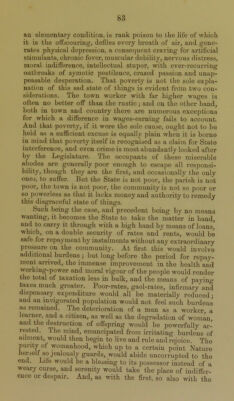
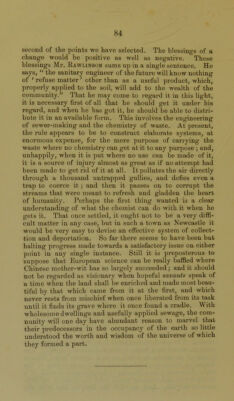
![[Editorial remarks on the preceding Paper, from the “ Newcastle Daily ChronicleTuesday, September 27th, 1870.] Mr. Rawlinson on Public Health. Anyone who has circulated, in an aimless and impartial way, through the several sections of tho Congress now sitting in Newcastle will have been occasionally bewildered by observing that each topic has been discussed as if it were undoubtedly of much higher importance than any other submitted to the members. Such an impression is incidental, however, to the arrangement which breaks up the subject-matter of social science into specific inquiries, and it deserves to be regarded as a proof that the arrange- ment is a wise one. It is plain that the field under cultivation by the Asso- ciation is a very wide one, and yet that it is one field, that no part of this field will be made the best of until the whole acreage has been effectively brought under tillage, and that the surest way of accomplishing the whole of the desired result is the allotment of separate portions to gangs of enthusiastic and specially-qualified workmen, who will resort to intellectual spade-labour in order that their respective portions may be thoroughly well wrought. This is exactly what has been done; and the result, so far as it can be apprehended by the unbiassed and perhaps not very philosophical mind of the average public, is that the sec- tional discussions have been extensively characterised by hobby-riding. When that result is nearer to maturity than it now is, there will appear to all, as even now there is visible to the more reflective portion of the community, a real unity of purpose and action, and that hobby-riding, when under efficient control, is not the worst way of reach- ing a winning-post safe and soon. The truth is that society is a complicated phenomenon, and the reforms suggested by its present condition, like the evils which disorder and afflict it, are at once closely related and infinitely varied. Thoughtlessness, ignorance, and sel- fishness are the sources of all the social maladies which still defy the zeal of philanthropy and the sagacity of states-](https://iiif.wellcomecollection.org/image/b28716656_0092.jp2/full/800%2C/0/default.jpg)
 No text description is available for this image
 No text description is available for this image
 No text description is available for this image