Licence: In copyright
Credit: Alcoholic fermentation / by Arthur Harden. Source: Wellcome Collection.
123/258 page 113
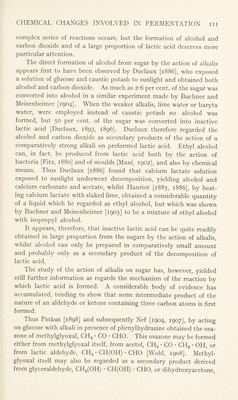
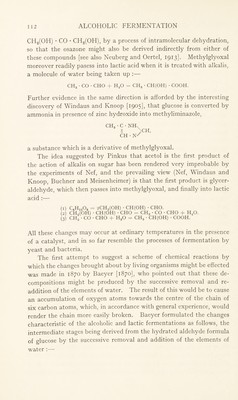
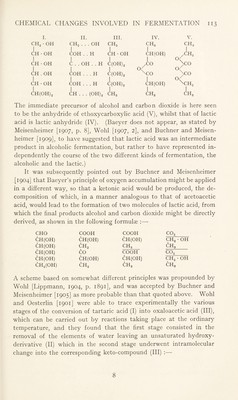
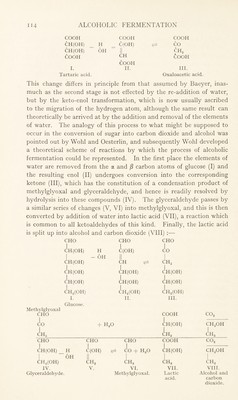
![I. CH2 • OH II. CH„ . . . OH III. ch3 IV. ch3 V. CH, | CH • OH | COH . . H 1 CH • OH 1 CH(OH) | /CH., °>o o< | CH • OH | C . .OH . .H i J C(OH)2 1 O -O V c CH . OH ■ COH . . . H C(OH)2 Nco Sco 1 CH • OH 1 COH . . 1 . H 1 C(OH), (l^H(OH) °\CH, | | CH(OH)2 1 CH . . . (OH)* | ch3 | ch3 ch3 The immediate precursor of alcohol and carbon dioxide is here seen to be the anhydride of ethoxycarboxylic acid (V), whilst that of lactic acid is lactic anhydride (IV). (Baeyer does not appear, as stated by Meisenheimer [1907, p. 8], Wohl [1907, 2], and Buchner and Meisen- heimer [1909], to have suggested that lactic acid was an intermediate product in alcoholic fermentation, but rather to have represented in- dependently the course of the two different kinds of fermentation, the alcoholic and the lactic.) It was subsequently pointed out by Buchner and Meisenheimer [1904] that Baeyer’s principle of oxygen accumulation might be applied in a different way, so that a ketonic acid would be produced, the de- composition of which, in a manner analogous to that of acetoacetic acid, would lead to the formation of two molecules of lactic acid, from which the final products alcohol and carbon dioxide might be directly derived, as shown in the following formulae :— CHO COOH COOH co2 CH(OH) CH(OH) CH(OH) CH2 • OH CH(OH) ch3 CH, ch3 CH(OH) CO COOH C02 C-H(OH) CH(OH) CH(OH) ch2 • OH CH2(OH) ch2 ch3 ch3 A scheme based on somewhat different principles was propounded by Wohl [Lippmann, 1904, p. 1891], and was accepted by Buchner and Meisenheimer [1905] as more probable than that quoted above. Wohl and Oesterlin [1901] were able to trace experimentally the various stages of the conversion of tartaric acid (I) into oxaloacetic acid (III), which can be carried out by reactions taking place at the ordinary temperature, and they found that the first stage consisted in the removal of the elements of water leaving an unsaturated hydroxy- derivative (II) which in the second stage underwent intramolecular change into the corresponding keto-compound (III) :— 8](https://iiif.wellcomecollection.org/image/b29808765_0123.jp2/full/800%2C/0/default.jpg)
 No text description is available for this image
 No text description is available for this image
 No text description is available for this image