Licence: In copyright
Credit: Alcoholic fermentation / by Arthur Harden. Source: Wellcome Collection.
125/258 page 115
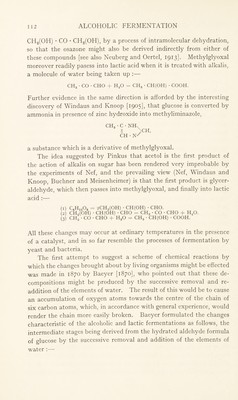
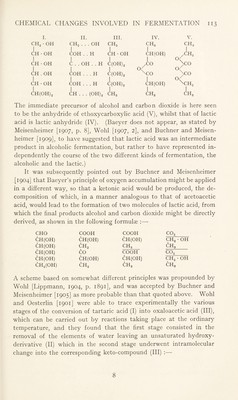
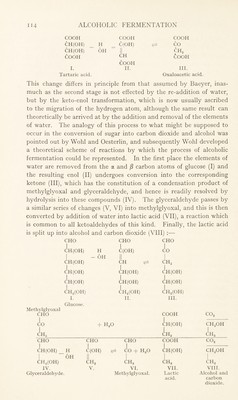
![This scheme agrees well with the current ideas as to the formation of lactic acid from glucose under the influence of alkalis (p. 112). It postulates the formation as intermediate products of no less than three compounds containing a chain of three carbon atoms—glyceraldehyde, methylglyoxal, and lactic acid. The Lactic Acid Theory of Alcoholic Fermentation. A practical interest was given to these various schemes by the fact that Buchner and Meisenheimer adduced experimental evidence in favour of the view that lactic acid is an intermediate product in the formation of alcohol and carbon dioxide from sugar by fermentation [1904, 1905, 1906, 1909]. These observers proved by a series of very careful analyses that yeast-juice frequently, but not invariably, contains small quantities of lactic acid, not exceeding 02 per cent. When yeast-juice is incubated alone or with sugar the amount of lactic acid may either increase or decrease. Moreover, lactic acid added to the juice is sometimes diminished and sometimes increased in quantity. On the whole, it appears that the addition of a considerable quantity of sugar or of some lactic acid favours the disappearance of lactic acid. Juices of low fermenting power produce a diminution in the lactic acid present, those of high fermenting power an increase. In all cases the amounts of lactic acid either produced or destroyed are very small in relation to the volume of the yeast-juice employed. Throughout the whole series of experiments the greatest increase amounted to 0-47 per cent, on the juice employed, and the greatest de- crease to 0-3 per cent. [See also Oppenheimer, 1914, 1.] Buchner and Meisenheimer at one time regarded these facts as strong evidence that lactic acid is an intermediate product of alcoholic fermentation. It was thought probable that the production of alcohol and carbon dioxide from sugar occurred in at least two stages and under the influence of two distinct enzymes. The first stage consisted in the conversion of sugar into lactic acid, and for the enzyme which brought about this decomposition was reserved the name zymase or yeast-zymase. The lactic acid was then broken down into alcohol and carbon dioxide by the second enzyme, lactacidase. This theory, which is quite in harmony with the current ideas as to the mode of decomposition of sugars by alkalis and is also consistent with Wold's scheme of reactions, is open to adverse criticism from several points of view. In the first place, it is noticeable that the total](https://iiif.wellcomecollection.org/image/b29808765_0125.jp2/full/800%2C/0/default.jpg)
 No text description is available for this image
 No text description is available for this image
 No text description is available for this image