Licence: In copyright
Credit: Alcoholic fermentation / by Arthur Harden. Source: Wellcome Collection.
129/258 page 119
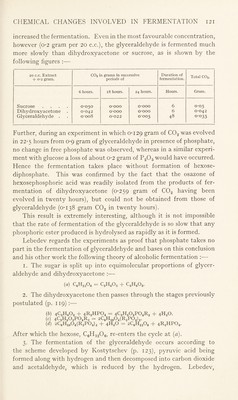
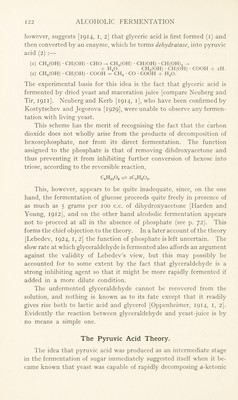
![autofermentation of the yeast (13 c.c.). A much greater effect was obtained by the aid of yeast-juice, and the remarkable observation was made that whilst yeast-juice alone produced comparatively little action a mixture of yeast-juice and boiled yeast-juice was much more effective, quantities of 20 to 50 c.c. of yeast-juice mixed with an equal volume of boiled juice, which in some experiments was concentrated, yielding with 0*4, I, and 2 grams of dihydroxyacetone almost the theoretical amount of carbon dioxide and alcohol in excess of that evolved in the absence of this substance. It was further observed that the fermentation of this substance commenced much more slowly than that of glucose. No explanation of either of these facts has at present been offered. The conclusion drawn from their experiments by Buchner and Meisen- heimer, that dihydroxyacetone is readily fermentable, was confirmed by Lebedev [1911, 1], who further made the important observation that during the fermentation of dihydroxyacetone the same hexose- phosphoric acid is produced as is formed during the fermentation of the hexoses. Lebedev accordingly propounded a scheme of alcoholic fermentation according to which the hexose was first converted into two molecules of triose, the latter being first esterified to triose- phosphoric acid and then condensed to hexosediphosphoric acid, which then underwent fermentation, being hydrolysed to phosphoric acid, and some unidentified substance, probably an unstable modification of a hexose, much more readily attacked by an appropriate enzyme than the original glucose or fructose [1911, 1, pp. 2941-2]. The idea that the sugar is first converted into triose and this into triosemonophosphoric acid had been previously suggested by Ivanov, who postulated the agency of a special enzyme termed synthease [1909, 1] and supposed that this triosemonophosphoric acid was then directly fermented to alcohol, carbon dioxide, and phosphoric acid. It has been shown that the arguments adduced by Ivanov in favour of the existence of his synthease are not valid [Harden and Young, 1910, i]. The fermentation of dihydroxyacetone was moreover proved by Harden and Young [1912] to be effected by yeast-juice and macera- tion extract at a much slower rate than that of the sugars, in spite of the fact that the addition of dihydroxyacetone did not inhibit the sugar fermentation. The same thing has been shown for living yeast by Slator [1912] in agreement with the earlier results of Buchner [1910] and Buchner and Meisenheimer [1910]. The logical conclusion from Lebedev’s experiments would appear rather to be that dihydroxyacetone is slowly condensed to a hexose](https://iiif.wellcomecollection.org/image/b29808765_0129.jp2/full/800%2C/0/default.jpg)
 No text description is available for this image
 No text description is available for this image
 No text description is available for this image