Licence: In copyright
Credit: Alcoholic fermentation / by Arthur Harden. Source: Wellcome Collection.
131/258 page 121
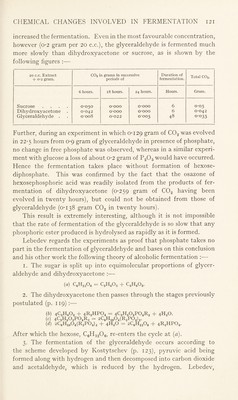
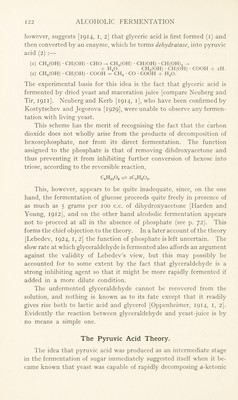
![increased the fermentation. Even in the most favourable concentration, however (02 gram per 20 c.c.), the glyceraldehyde is fermented much more slowly than dihydroxyacetone or sucrose, as is shown by the following figures :— 20 c.c. Extract -f 0-2 gram. CO2 in grams in successive period? of Duration of fermentation. Total C02. 6 hours. 18 hours. 24 hours. Hours. Gram. Sucrose .... 0-050 o-ooo o-ooo 6 0-05 Dihydroxyacetone 0-042 o-ooo o-ooo 6 0-042 Glyceraldehyde . 0 008 0-022 0-005 48 0-035 Further, during an experiment in which 0-129 gram of C02 was evolved in 22-5 hours from 0-9 gram of glyceraldehyde in presence of phosphate, no change in free phosphate was observed, whereas in a similar experi- ment with glucose a loss of about 0-2 gram of P205 would have occurred. Hence the fermentation takes place without formation of hexose- diphosphate. This was confirmed by the fact that the osazone of hexosephosphoric acid was readily isolated from the products of fer- mentation of dihydroxyacetone (0-259 gram of C02 having been evolved in twenty hours), but could not be obtained from those of glyceraldehyde (0-138 gram C02 in twenty hours). This result is extremely interesting, although it is not impossible that the rate of fermentation of the glyceraldehyde is so slow that any phosphoric ester produced is hydrolysed as rapidly as it is formed. Lebedev regards the experiments as proof that phosphate takes no part in the fermentation of glyceraldehyde and bases on this conclusion and his other work the following theory of alcoholic fermentation :— 1. The sugar is split up into equimolecular proportions of glycer- aldehyde and dihydroxyacetone :— (a) C6H1206 = C3H603 + C3H603. 2. The dihydroxyacetone then passes through the stages previously postulated (p. 119) :— (b) 4c3h6o3 + 4r2hpo4 - 4C3H502P04R2 + 4h2o. (c) 4c3h6o2po4r2 = 2C6H10O4(R2PO4)2. (d) 2C6H10O4(R2PO4)2 + 4H20 = 2C6H1206 + 4r.2hpo4. After which the hexose, C6H]206, re-enters the cycle at (a). 3. The fermentation of the glyceraldehyde occurs according to the scheme developed by Kostytschev (p. 123), pyruvic acid being formed along with hydrogen and then decomposed into carbon dioxide and acetaldehyde, which is reduced by the hydrogen. Lebedev,](https://iiif.wellcomecollection.org/image/b29808765_0131.jp2/full/800%2C/0/default.jpg)
 No text description is available for this image
 No text description is available for this image
 No text description is available for this image