Licence: In copyright
Credit: Alcoholic fermentation / by Arthur Harden. Source: Wellcome Collection.
146/258 page 136
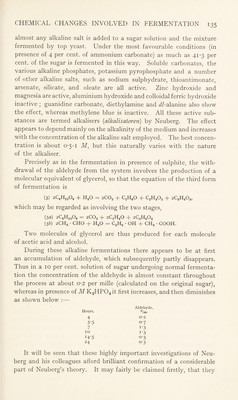
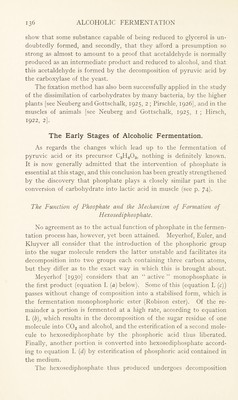
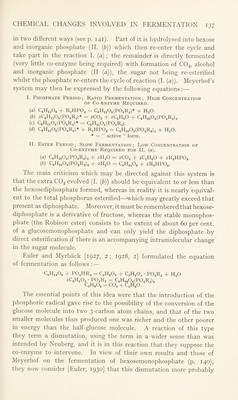
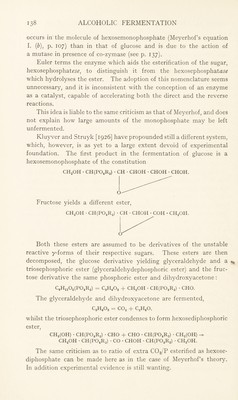
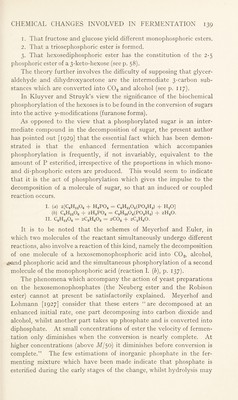
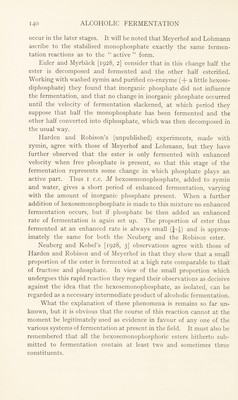
![show that some substance capable of being reduced to glycerol is un- doubtedly formed, and secondly, that they afford a presumption so strong as almost to amount to a proof that acetaldehyde is normally produced as an intermediate product and reduced to alcohol, and that this acetaldehyde is formed by the decomposition of pyruvic acid by the carboxylase of the yeast. The fixation method has also been successfully applied in the study of the dissimilation of carbohydrates by many bacteria, by the higher plants [see Neuberg and Gottschalk, 1925, 2 ; Pirschle, 1926], and in the muscles of animals [see Neuberg and Gottschalk, 1925, 1 ; Hirsch, 1922, 2]. The Early Stages of Alcoholic Fermentation. As regards the changes which lead up to the fermentation of pyruvic acid or its precursor C3H603, nothing is definitely known. It is now generally admitted that the intervention of phosphate is essential at this stage, and this conclusion has been greatly strengthened by the discovery that phosphate plays a closely similar part in the conversion of carbohydrate into lactic acid in muscle (see p. 74). The Function of Phosphate and the Mechanism of Formation of Hexosediphosphate. No agreement as to the actual function of phosphate in the fermen- tation process has, however, yet been attained. Meyerhof, Euler, and Kluyver all consider that the introduction of the phosphoric group into the sugar molecule renders the latter unstable and facilitates its decomposition into two groups each containing three carbon atoms, but they differ as to the exact way in which this is brought about. Meyerhof [1930] considers that an “ active ” monophosphate is the first product (equation I. (a) below). Some of this (equation I. (c)) passes without change of composition into a stabilised form, which is the fermentation monophosphoric ester (Robison ester). Of the re- mainder a portion is fermented at a high rate, according to equation I. (b), which results in the decomposition of the sugar residue of one molecule into C02 and alcohol, and the esterification of a second mole- cule to hexosediphosphate by the phosphoric acid thus liberated. Finally, another portion is converted into hexosediphosphate accord- ing to equation I. (d) by esterification of phosphoric acid contained in the medium. The hexosediphosphate thus produced undergoes decomposition](https://iiif.wellcomecollection.org/image/b29808765_0146.jp2/full/800%2C/0/default.jpg)
 No text description is available for this image
 No text description is available for this image
 No text description is available for this image