Licence: In copyright
Credit: Alcoholic fermentation / by Arthur Harden. Source: Wellcome Collection.
163/258 page 153
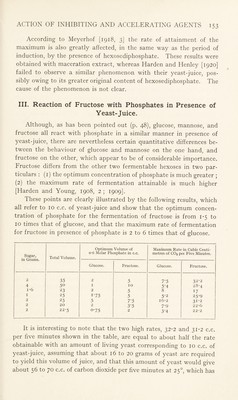
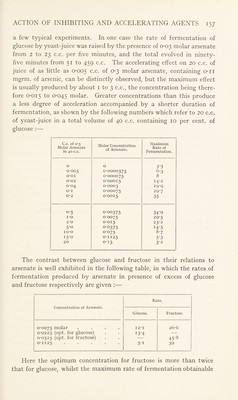
![According to Meyerhof [1918, 3] the rate of attainment of the maximum is also greatly affected, in the same way as the period of induction, by the presence of hexosediphosphate. These results were obtained with maceration extract, whereas Harden and Henley [1920] failed to observe a similar phenomenon with their yeast-juice, pos- sibly owing to its greater original content of hexosediphosphate. The cause of the phenomenon is not clear. III. Reaction of Fructose with Phosphates in Presence of Yeast-Juice. Although, as has been pointed out (p. 48), glucose, mannose, and fructose all react with phosphate in a similar manner in presence of yeast-juice, there are nevertheless certain quantitative differences be- tween the behaviour of glucose and mannose on the one hand, and fructose on the other, which appear to be of considerable importance. Fructose differs from the other two fermentable hexoses in two par- ticulars : (1) the optimum concentration of phosphate is much greater ; (2) the maximum rate of fermentation attainable is much higher [Harden and Young, 1908, 2 ; 1909]. These points are clearly illustrated by the following results, which all refer to 10 c.c. of yeast-juice and show that the optimum concen- tration of phosphate for the fermentation of fructose is from 1-5 to IO times that of glucose, and that the maximum rate of fermentation for fructose in presence of phosphate is 2 to 6 times that of glucose. Sugar, in Grams. Total Volume. Optimum Volume of o-6 Molar Phosphate in c.c. Maximum Rate in Cubic Centi- metres of C02 per Five Minutes. Glucose. Fructose. Glucose. Fructose. 2 35 2 5 7‘5 32*2 4 50 I 10 5*4 28*4 i*6 23 2 5 8 17 1 25 i'75 5 5*2 25-9 2 25 5 7'5 16-2 31-2 2 20 2 3*5 7-9 22-6 2 22’5 o-75 2 3H 22-2 It is interesting to note that the two high rates, 32-2 and 31-2 c.c. per five minutes shown in the table, are equal to about half the rate obtainable with an amount of living yeast corresponding to 10 c.c. of yeast-juice, assuming that about 16 to 20 grams of yeast are required to yield this volume of juice, and that this amount of yeast would give about 56 to 70 c.c. of carbon dioxide per five minutes at 250, which has](https://iiif.wellcomecollection.org/image/b29808765_0163.jp2/full/800%2C/0/default.jpg)
 No text description is available for this image
 No text description is available for this image
 No text description is available for this image