Licence: In copyright
Credit: Alcoholic fermentation / by Arthur Harden. Source: Wellcome Collection.
168/258 page 158
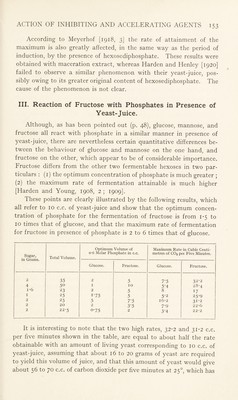
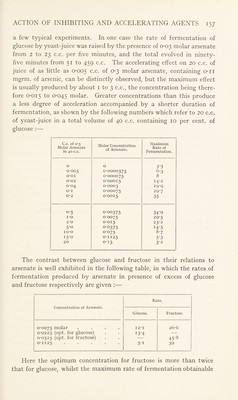
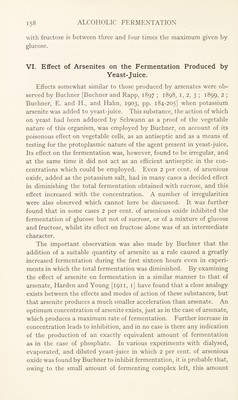
![with fructose is between three and four times the maximum given by glucose. VI. Effect of Arsenites on the Fermentation Produced by Yeast-Juice. Effects somewhat similar to those produced by arsenates were ob- served by Buchner [Buchner and Rapp, 1897 5 1898, 1, 2, 3 ; 1899, 2 ; Buchner, E. and H., and Hahn, 1903, pp. 184-205] when potassium arsenite was added to yeast-juice. This substance, the action of which on yeast had been adduced by Schwann as a proof of the vegetable nature of this organism, was employed by Buchner, on account of its poisonous effect on vegetable cells, as an antiseptic and as a means of testing for the protoplasmic nature of the agent present in yeast-juice. Its effect on the fermentation was, however, found to be irregular, and at the same time it did not act as an efficient antiseptic in the con- centrations which could be employed. Even 2 per cent, of arsenious oxide, added as the potassium salt, had in many cases a decided effect in diminishing the total fermentation obtained with sucrose, and this effect increased with the concentration. A number of irregularities were also observed which cannot here be discussed. It was further found that in some cases 2 per cent, of arsenious oxide inhibited the fermentation of glucose but not of sucrose, or of a mixture of glucose and fructose, whilst its effect on fructose alone was of an intermediate character. The important observation was also made by Buchner that the addition of a suitable quantity of arsenite as a rule caused a greatly increased fermentation during the first sixteen hours even in experi- ments in which the total fermentation was diminished. By examining the effect of arsenite on fermentation in a similar manner to that of arsenate, Harden and Young [1911, 1] have found that a close analogy exists between the effects and modes of action of these substances, but that arsenite produces a much smaller acceleration than arsenate. An optimum concentration of arsenite exists, just as in the case of arsenate, which produces a maximum rate of fermentation. Further increase in concentration leads to inhibition, and in no case is there any indication of the production of an exactly equivalent amount of fermentation as in the case of phosphate. In various experiments with dialysed, evaporated, and diluted yeast-juice in which 2 per cent, of arsenious oxide was found by Buchner to inhibit fermentation, it is probable that, owing to the small amount of fermenting complex left, this amount](https://iiif.wellcomecollection.org/image/b29808765_0168.jp2/full/800%2C/0/default.jpg)
 No text description is available for this image
 No text description is available for this image
 No text description is available for this image