Licence: In copyright
Credit: Alcoholic fermentation / by Arthur Harden. Source: Wellcome Collection.
192/258 page 182
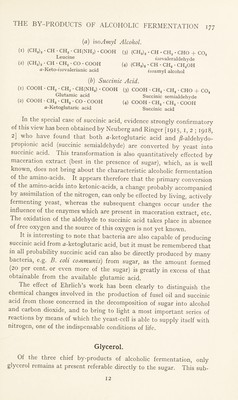
![phosphate (present in the yeast extract), so that at least four factors were being altered instead of only two. In a series of kinetic experiments Euler and Kullberg [1911, 3] found that the conversion of phosphate into hexosephosphate in presence of excess of glucose proceeded according to a unimolecular reaction, the temperature coefficient being 175 for io° C. The rate of fermentation is diminished by dilution of the yeast- juice, but less rapidly than the concentration of the juice. Herzog found that when the relation between concentration of enzyme and the velocity constant of the reaction is expressed by the formula kjk2 = (C1/C2)n where kx and k2 are the velocity constants corre- sponding with the enzyme concentrations Cx and C2, the value for n is 2 for zymin, whilst Euler working with yeast-juice obtained values varying from 1*29 to 1*67 and decreasing as k increased. As, however, the exact significance of k in these ratios is doubtful (see p. 180), that of n is also uncertain. The temperature coefficient of fermentation by zymin was found by Herzog to be Q24.5/i4.5° — 2-88, which agrees well with the value found by Slator for yeast-cells (p. 190). Since Herzog measured the basal rate of fermentation, this co- efficient probably applies to the enzyme or enzymes concerned in the liberation of phosphate from hexosephosphate. Fermentation in the Yeast Cell. When we endeavour to apply the results of the investigations of the fermentation of sugar by yeast-juice, zymin, etc., to the process which goes on in the living cell, considerable difficulties present them- selves. A scheme of fermentation in the living cell can, however, easily be imagined, which is in harmony with these results. According to the most simple form of this ideal scheme, the sugar which has diffused into the cell unites with the fermenting complex and undergoes the characteristic reaction with phosphate, already present in the cell, yielding carbon dioxide, alcohol, and hexosephosphate. The latter is then decomposed, just as it is in yeast-juice, but more rapidly, and the liberated phosphate again enters into reaction, partly with the sugar formed from the hexosephosphate and partly with fresh sugar supplied from outside the cell. The main difference between fermentation by yeast-juice and by the living cell would then consist in the rate of decomposition of the hexosephosphate, for it has been shown that yeast- juice in presence of sufficient phosphate can ferment sugar at a rate](https://iiif.wellcomecollection.org/image/b29808765_0192.jp2/full/800%2C/0/default.jpg)
 No text description is available for this image
 No text description is available for this image
 No text description is available for this image